The trouble with working on a fixed term contract is that there comes a time when you have to move on. My five-year contract in Senegal was extended to a sixth year, and then to a seventh, but seven is the maximum allowed and I am already several months into my seventh year, so when a suitable post was advertised in Panama (the same job that I do here but covering our Latin America region) I really had little choice but to apply.
I was successful, and within the next couple of months (I don't yet have a transfer date), I will be leaving my beloved West Africa.
Of course my new region will be full of delights. New landscapes, new birds, new cultures, new music... Many things that I should be so excited about. & I guess that, in time, I will be excited about them. But now all I can think about is how much I will miss Africa. How much I love Africa. How challenging and frustrating it can be, and how long it took me to find my place here but how happy I am now that I have found it.
Don't post comments about any of the delights of my new region or of the advantages of living in Panama, because I know all that, and at the moment it makes no difference. That isn't to say you should be sad for me... I am busy trying to see the last few corners of this region that remain unexplored (the Benin voodoo festival, and next month the Bissau carnival), to make the most of the little time that remains and to celebrate and be thankful for the wonderful years I have spent here. I have been very lucky to have the opportunity to explore a region of the world that so few people know.

Ouidah voodoo festival
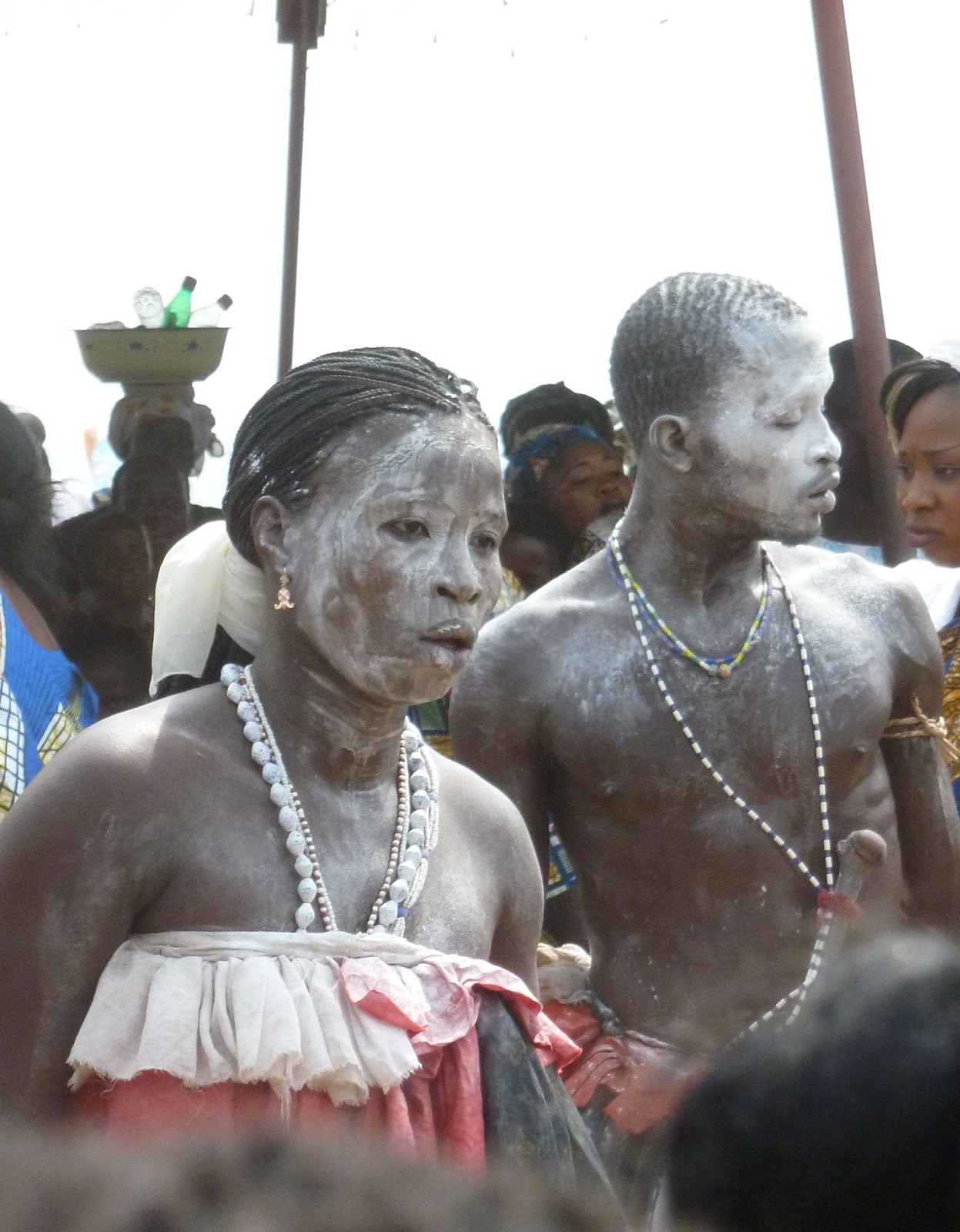 Every year on 10 January, Benin celebrates its national religion with a festival in the coastal town of Ouidah (a place also known for its slave-trading history). I've never managed to schedule a work-related trip to Benin in January, so I bit the bullet this year and bought my own flights so as to visit this festival.
So the voodoo festival in Ouidah would have to do as second best. & I feel I should be careful here in any case not to give the wrong impression of voodoo - the Hollywood impression of a set of dark and perhaps evil practices - as the religion is not based around trances and animal sacrifices, those play only a small part related to major problems or events in people's lives. The day-to-day practice of voodoo is far more mundane.
I found no information about this festival on the internet other than the date, and even on a trip to Benin in December no-one could give me any information, so I turned up not really knowing what to expect - even whether I would find the festival! I arrived in Ouidah late the evening before, found myself a hotel room, and asked the hotel manager what was going to happen. There will be a big procession to the beach, he told me, and after the official ceremony, there would be "voodoo here, voodoo there, voodoo everywhere!", waving his hands about excitedly. Voodoo is indeed everywhere in Ouidah (and in much of Benin and parts of neighbouring Togo), as it is the national religion. You see little shrines next to houses, often sticky with the residue of earlier sacrifices (usually of beer or grain porridges, rather than animals), and various buildings with voodoo symbols painted on them (a rainbow, or a snake, for example). But I didn't fly all this way, for a two-day visit, to see a fetish or a painted building.
On the day of the festival I followed my hunch - a sound of singing and clapping which I traced to its origin in the local chief's house. In return for a $10 payment for a 'photo permit' I was allowed in, and watched the chief and his entourage prepare, then we left in a big chaotic procession towards the python temple, with all the chief's family and guests dressed in their ceremonial finery.

Ouidah apparently means, in the local language, 'town of pythons' and the python is the most important local deity, so sacrifices had to be made there before the festival could start. Two goats and two chickens were the victims, presumably fed to the pythons later.
Then we made our way the 4km to the beach (the chiefs in their 4x4s, me on the back of a motorbike taxi) for the festival. This was a strange event, formal in some ways (the US Ambassador was there, and Benin TV were broadcasting it live), but as well as the speeches and displays of drumming and dancing from the main stage of the big square, there were more animal sacrifices performed away from the stage, and various private dances with frenetic drumming in corners (including those in the first photo above) - mostly far more interesting, and with a far more authentic feel, than that put on for the Ambassador and the TV.
Walking back into town after the formalities were over I passed another troupe of dancers heading towards the beach area - looking at the photos afterwards I had to ask myself why I hadn't followed them. Bare breasts, grass skirts, ointment smeared over their bodies and the prospect of some wild dancing - I have to admit that as much as I want Africa to develop (clean water and education for all, but also further into the 21st century), it is this traditional, even 'primitive' side of the continent that really draws me in.
Revisiting this post to add a further comment, as my lack of articulacy in the last paragraph was bothering me. What I was trying to reflect was the conflict I so often face between the sensational and the mundane, in terms of representing Africa in my blog. Of course I am more attracted by exploring (and writing about) the sensational side, but at the same time I don't want to give the wrong impression of the continent. Bare-breasted women in grass skirts dancing around blood-smeared fetishes to the beat of frenetic drumming is something I want to see and write about, and is a valid image of a part of Africa, but it no more represents the wider African continent (nor even the voodoo religion) than a burnt-out car on a Belfast street represents the wider UK. & I thought it was important to come back and make this clear, because so much of what one reads about Africa relies on stereotypical images of the place as primitive, poor, corrupt, disease-ridden, etc - and whilst those images do represent a part of the truth, it is only a small part, and I don't want to contribute to an overall negative view of this continent that I love so much.
Revisiting this post to add a further comment, as my lack of articulacy in the last paragraph was bothering me. What I was trying to reflect was the conflict I so often face between the sensational and the mundane, in terms of representing Africa in my blog. Of course I am more attracted by exploring (and writing about) the sensational side, but at the same time I don't want to give the wrong impression of the continent. Bare-breasted women in grass skirts dancing around blood-smeared fetishes to the beat of frenetic drumming is something I want to see and write about, and is a valid image of a part of Africa, but it no more represents the wider African continent (nor even the voodoo religion) than a burnt-out car on a Belfast street represents the wider UK. & I thought it was important to come back and make this clear, because so much of what one reads about Africa relies on stereotypical images of the place as primitive, poor, corrupt, disease-ridden, etc - and whilst those images do represent a part of the truth, it is only a small part, and I don't want to contribute to an overall negative view of this continent that I love so much.

Christmas in Extremadura
It was hard to know where to go for Christmas. I had to take some leave or lose it, and I knew that if I stayed in Dakar I would end up "popping into the office to see if there are any urgent emails" (= spending my leave at work) so I had to go somewhere. Flights from/within Africa are generally expensive, and I had already taken holidays in all of Senegal's neighbouring countries - then I saw a trip advertised to Extremadura, in the west of Spain. Birdwatching, but with a company who don't take it too seriously - that is, they (and their typical clientele) are happy to stop to look at views/ruins/butterflies and not keen to spend three hours trying to coax a little brown bird out of a bush, unless it is an extremely rare little brown bird.
So I flew to Madrid with a case full of jumpers and thermals, and joined a group of Brits on a birdwatching trip. I won't list the 100-odd bird species we saw, but they included cranes, storks, bustards, owls
 and a wonderful view of the extremely rare Spanish imperial eagle. Only a few hundred of these birds are left, and one sat on a rock in full view for a good half-hour, before flying off slowly (for those not into birds, the photo is a little owl, not a Spanish imperial eagle...).
When the others returned to Madrid for their flights home I stayed on for a few days. Extremadura has a number of old hill towns full of well-preserved old monuments, so after a quick visit to Trujillo I made my way to Cáceres. Here the extensive 'monument district' on the top of the hill, within an old city wall (including one remaining Roman gate), is full of grand, powerful-looking palaces, next to narrow, winding streets and alleyways. There is also an old Arab underground cistern, and an interesting museum. I ws particularly impressed by some ornate bronze bedsteads dating from the 7th-8th centuries BC.

Of course it was cold, with a damp, cold mist most mornings. Stopping off in the bars for the odd glass of red wine and free plate of tapas kept me going but I was relieved to get home to the warmth and light of Africa. Nothing beats stepping onto the balcony in a Tshirt to watch the New Year's Eve fireworks!
So I flew to Madrid with a case full of jumpers and thermals, and joined a group of Brits on a birdwatching trip. I won't list the 100-odd bird species we saw, but they included cranes, storks, bustards, owls

When the others returned to Madrid for their flights home I stayed on for a few days. Extremadura has a number of old hill towns full of well-preserved old monuments, so after a quick visit to Trujillo I made my way to Cáceres. Here the extensive 'monument district' on the top of the hill, within an old city wall (including one remaining Roman gate), is full of grand, powerful-looking palaces, next to narrow, winding streets and alleyways. There is also an old Arab underground cistern, and an interesting museum. I ws particularly impressed by some ornate bronze bedsteads dating from the 7th-8th centuries BC.

Of course it was cold, with a damp, cold mist most mornings. Stopping off in the bars for the odd glass of red wine and free plate of tapas kept me going but I was relieved to get home to the warmth and light of Africa. Nothing beats stepping onto the balcony in a Tshirt to watch the New Year's Eve fireworks!
Mud marvels in Mali
It was a great feeling - one of exhilaration - as the 5am bus pulled away from the dark little side-street in central Bamako to start the 580km trip north-east to Djenne.
I first visited Djenne 13 years ago, and I wasn't going to let coups, rebellions or ill-informed foreign office advice stop me from going back. I'd checked and double-checked and Djenne is safe. But with much of Mali currently so unsafe there are no tourists coming, and with the embassies advising against all travel to Mali even the business travellers are leaving as quickly as they can - so I knew that I would have Djenne all to myself.

& so it proved. Djenne is a UNESCO World Heritage site, an ancient city on the trans-Saharan trade route almost entirely built of mud, and with the largest mud structure in the world (its mosque), so tourism has been an important source of income. But with the kidnappings in Timbuktu last year it pretty much dried up, and then with the coup this March it stopped completely. So all those who make their money from tourism - those who run and work in hotels and restaurants, who make or sell masks, statues, jewellery and bogolan cloth, those working as guides (and their extended families) - all have suffered. This meant, rather embarrassingly, that I was treated as some kind of messiah, with little old ladies coming and taking my hands and praising god that there was a white person in Djenne, finally.
I hope I didn't raise any false hopes (please, readers, go to Djenne, and spend money there!) but it was nice to feel so welcome and wonderful to wander the streets and visit a couple of nearby villages without seeing another tourist. The need for tourist $ also meant I was allowed inside the famous mosque, nornally off-limits to tourists (although to be honest the interior turned out to be far less impressive than the exterior).
Djenne is a truly beautiful place, one of my favourite towns/cities in the world. Buildings are built with banco (mud mixed with millet straw) in traditional styles maintained by a strict guild of masons, and are regularly replastered to counter rain damage. Located in the Niger inland delta, the surrounding land is a floodplain, underwater for several months of the year. During my visit the water had only partly receded, so the town was effectively an island reachable only by crossing a bridge or taking a ride in a pirogue.
Sunday is one of the quiet days when I was able to wander the little backstreets enjoying the architecture. Monday, on the other hand, is the day of the weekly market, with thousands of people arriving from the surrounding villages to bring fish, vegetables and bundles of firewood for sale. It is a typical colourful African market - of which, of course, I have seen dozens - but looking out from the town at all the traders crossing the floodwater in little wooden pirogues was certainly worthwhile.

In the afternoon I escaped the market crowds by taking a guide to visit two nearby villages, one inhabited by the Bozo (fishermen) and accessible only by boat,
 the other with a mixture of different tribes in different sections, each with their own small mud mosque.
Then, unfortunately, the long and tiring bus ride back to Bamako. It should take about 10 hours, but in a particularly old bus, and with a driver who seemed cdetermined to stop to pick up as many passengers (and their chickens) as possible, it took us 18 hours. But for Djenne, it was worth it.
A birthday break
How do you celebrate a major birthday in my position? Ten years ago, and ten years before that, it was through travel to special new parts of the world. Somehow that didn’t seem so appropriate this year – not that there aren’t still many countries I would really love to go to, but travel is now a normal part of my life so it wouldn’t have marked this birthday out as special.
I thought about gathering my local friends together for a big dinner in Dakar, but ruled that out quickly as it would have meant telling them why, thus making me the centre of attention for the evening, which I would hate. I thought too about a few days’ luxury in a top hotel somewhere like Venice, but really that would be more enjoyable as part of a couple.


The food was great too. Set meals with no choice whatsoever, but I was perfectly happy with dishes such as pumpkin and prawn soup and grouper fillet flambéed in tamarind sauce. I didn’t drink much but their Cape Verdean rum cocktails were also pretty good!
I thought about gathering my local friends together for a big dinner in Dakar, but ruled that out quickly as it would have meant telling them why, thus making me the centre of attention for the evening, which I would hate. I thought too about a few days’ luxury in a top hotel somewhere like Venice, but really that would be more enjoyable as part of a couple.
Then I remembered what I had read about an eco-lodge called the Collines de Niassam in Senegal, some 150km down the coast from Dakar near the villages of Palmarin. I’d been to Palmarin before, and loved the area. Just getting there involves an hour or more of driving across bare, open salt flats, with little to see except bare earth, water, sky and birds. It’s a bleak yet majestic landscape. The lodge offers a little bit of luxury amongst this bleakness, but in a development that blends in with the landscape rather than shutting it out.

So I booked myself for a couple of nights into one of their four wooden huts built on stilts above a lagoon. There are activities on offer, and I went on an evening drive in a horse and cart to watch hyenas gather before their evening hunt, but otherwise I just relaxed. A colleague had brought me an English Sunday newspaper the week before, which I had saved, but I spent a lot of time just sitting in a deck chair gazing at the lagoon – at the herons, gulls, avocets and pelicans that were a constant presence outside my room. I also went walking in the bush – yes, more birds, but also the physical pleasure of just walking, knowing I was in a reserve and so would not encounter demands for presents from snivelling children, nor their parents trying to sell me necklaces or poor quality carvings. In fact I didn’t see anyone during either of my two long (2-3 hour) walks, just hornbills, bee-eaters, kingfishers, parrots and francolins. On the drive to the hyenas I also saw flamingos and jackals.

Mission (just about) accomplished
I was tired when I got home from Cambodia (via Istanbul), and the last thing I really wanted to hear was that my staff were having problems in Niger and I needed to join them as soon as possible in order to rescue the mission.
It turned out that none of the planning had been done as one team member had been confined to bed with a painful attack of gout. The other team member had arrived in Niger late after her flight was delayed by ten hours, and also stressed from her experience on the flight. Stopped at Bamako for some passengers to leave and others to join the flight, she suddenly realised her laptop was missing. In her distress she managed to persuade the crew to let her briefly disembark to chase after the departing passengers, and finding them still in the terminal she announced that her laptop was missing and she wanted everyone to open their bags. A man who'd been sitting near her (and trying unsuccessfully to chat her up for much of the flight) came forward and handed it over. He'd thought it belonged to another woman who'd got off the flight, blah, blah, blah...
Perhaps her immune system was down after the stresses of her journey, as she then fell sick with malaria and spent the next five days in bed.
So they needed me to join them much earlier than intended so as to take on some of the work. I ran around changing my flight, getting an additional few days' visa, etc (all made more difficult by the fact that all of my admin and logistics colleagues were away on a training course), and flew out to join them on the Saturday evening. Due to full hotels we were all staying in different places, so they had agreed to bring a big pile of files to me on the Sunday as preparatory reading for my intended two days out in the field visiting projects, but the taxi drivers were all on strike so I had to sit there twiddling my thumbs until an office driver got to me on the Monday morning. Laden down with the files we drove the 160km to the Dosso field office, and after the day's work I spent the evening, until midnight, on my reading. There was little else to do in any case as the hotel restaurant was closed and with no street lighting and no torch I was restricted to a beer from the hotel bar for my dinner.
The next morning I was therefore quite hungry and could hardly believe it when told that the restaurant was still closed, with the chef not expected in for another couple of hours. So I wandered out into the street, searching for somewhere selling food. As Dosso is a kind of crossroads for travellers (mostly truckers) going from Niger to Benin or Nigeria, I quickly found somewhere. No menu, just a chunk of baguette served with hot white beans, a dollop of mayonnaise and a glug of oil, but it was nicer than it sounds and a bargain at only 40¢.
Once in the office, I gave them the list of projects I wanted to visit so that they could make the necessary arrangements. They came back looking concerned. There had been a kidnapping of six NGO staff on the Sunday night, so apparently meetings had been held the previous day between security officers of the NGOS and the UN agencies, and the decision had been made to stop all field visits. I was also told that there was to be no movement between the country office and the field offices, so I had to stay put. With two policemen guarding my room that night!
I have to say that I felt it was all a huge overreaction; the kidnap had taken place 650km away, and as the kidnappers now had six hostages to deal with I thought it unlikely that they would be on the hunt for more. Besides, this wasn't the first kidnapping of NGO staff in Niger over the past few years. But I am not an expert on security matters, and obviously had to do what I was told in the circumstances.
Overreaction or not, it meant I couldn't carry out the work that was my reason for going to Dosso, so the next day they agreed to transport me back to Niamey.
Thankfully the other half of our planned project vists had been done a couple of days earlier so we were still able to draw some conclusions from our trip and produce a final report.
Time to go home, and although our homes are in different places the first leg of the journey, Niamey - Ouagadougou, was the same for all three so we travelled together to the airport early on the Wednesday morning. This trip hadn't done with us yet though, as we found that the aeroplane had not arrived the previous evening, and with no other flights departing Niamey that day we could not be re-routed. So we were sent back to the hotel to wait. A chance to phone my Mum, to take a dip in the pool, it wasn't all bad, but at the same time I really had been away for long enough and was keen to get home. Friday was a public holiday so I had a long weekend to look forward to.
Eventually, late afternoon, we got the call to go back to the airport; the plane had finally arrived. At check-in I was asked whether I wanted to collect my luggage in Ouagadougou or check it through to Dakar. I pointed out that as I had missed the midday connection with the Dakar flight it was a bit difficult to answer without more information on the rearranged connection. At this they looked a little confused - it turned out they hadn't thought about that so I hadn't been booked on to any new connecting flight.
After more than an hour waiting for information, I was told that unfortunately the next flight from Ouaga to Dakar was not until Friday lunchtime and so I would have to spend two nights in transit in Ouagadougou. I was not pleased but of course there was nothing I could do. In fact I was nearly removed from the Friday flight as I refused point blank to pay $50 for a transit visa, arguing that it was the airline's fault and so they would have to pay. Fine in theory but all the airline's staff were off enjoying the public holiday... But I made the flight and finally collapsed into bed at home on Friday night.
Getting things done in Africa is rarely easy but this trip had managed to really pack in the challenges.
It turned out that none of the planning had been done as one team member had been confined to bed with a painful attack of gout. The other team member had arrived in Niger late after her flight was delayed by ten hours, and also stressed from her experience on the flight. Stopped at Bamako for some passengers to leave and others to join the flight, she suddenly realised her laptop was missing. In her distress she managed to persuade the crew to let her briefly disembark to chase after the departing passengers, and finding them still in the terminal she announced that her laptop was missing and she wanted everyone to open their bags. A man who'd been sitting near her (and trying unsuccessfully to chat her up for much of the flight) came forward and handed it over. He'd thought it belonged to another woman who'd got off the flight, blah, blah, blah...
Perhaps her immune system was down after the stresses of her journey, as she then fell sick with malaria and spent the next five days in bed.
So they needed me to join them much earlier than intended so as to take on some of the work. I ran around changing my flight, getting an additional few days' visa, etc (all made more difficult by the fact that all of my admin and logistics colleagues were away on a training course), and flew out to join them on the Saturday evening. Due to full hotels we were all staying in different places, so they had agreed to bring a big pile of files to me on the Sunday as preparatory reading for my intended two days out in the field visiting projects, but the taxi drivers were all on strike so I had to sit there twiddling my thumbs until an office driver got to me on the Monday morning. Laden down with the files we drove the 160km to the Dosso field office, and after the day's work I spent the evening, until midnight, on my reading. There was little else to do in any case as the hotel restaurant was closed and with no street lighting and no torch I was restricted to a beer from the hotel bar for my dinner.
The next morning I was therefore quite hungry and could hardly believe it when told that the restaurant was still closed, with the chef not expected in for another couple of hours. So I wandered out into the street, searching for somewhere selling food. As Dosso is a kind of crossroads for travellers (mostly truckers) going from Niger to Benin or Nigeria, I quickly found somewhere. No menu, just a chunk of baguette served with hot white beans, a dollop of mayonnaise and a glug of oil, but it was nicer than it sounds and a bargain at only 40¢.
Once in the office, I gave them the list of projects I wanted to visit so that they could make the necessary arrangements. They came back looking concerned. There had been a kidnapping of six NGO staff on the Sunday night, so apparently meetings had been held the previous day between security officers of the NGOS and the UN agencies, and the decision had been made to stop all field visits. I was also told that there was to be no movement between the country office and the field offices, so I had to stay put. With two policemen guarding my room that night!
I have to say that I felt it was all a huge overreaction; the kidnap had taken place 650km away, and as the kidnappers now had six hostages to deal with I thought it unlikely that they would be on the hunt for more. Besides, this wasn't the first kidnapping of NGO staff in Niger over the past few years. But I am not an expert on security matters, and obviously had to do what I was told in the circumstances.
Overreaction or not, it meant I couldn't carry out the work that was my reason for going to Dosso, so the next day they agreed to transport me back to Niamey.
Thankfully the other half of our planned project vists had been done a couple of days earlier so we were still able to draw some conclusions from our trip and produce a final report.
Time to go home, and although our homes are in different places the first leg of the journey, Niamey - Ouagadougou, was the same for all three so we travelled together to the airport early on the Wednesday morning. This trip hadn't done with us yet though, as we found that the aeroplane had not arrived the previous evening, and with no other flights departing Niamey that day we could not be re-routed. So we were sent back to the hotel to wait. A chance to phone my Mum, to take a dip in the pool, it wasn't all bad, but at the same time I really had been away for long enough and was keen to get home. Friday was a public holiday so I had a long weekend to look forward to.
Eventually, late afternoon, we got the call to go back to the airport; the plane had finally arrived. At check-in I was asked whether I wanted to collect my luggage in Ouagadougou or check it through to Dakar. I pointed out that as I had missed the midday connection with the Dakar flight it was a bit difficult to answer without more information on the rearranged connection. At this they looked a little confused - it turned out they hadn't thought about that so I hadn't been booked on to any new connecting flight.
After more than an hour waiting for information, I was told that unfortunately the next flight from Ouaga to Dakar was not until Friday lunchtime and so I would have to spend two nights in transit in Ouagadougou. I was not pleased but of course there was nothing I could do. In fact I was nearly removed from the Friday flight as I refused point blank to pay $50 for a transit visa, arguing that it was the airline's fault and so they would have to pay. Fine in theory but all the airline's staff were off enjoying the public holiday... But I made the flight and finally collapsed into bed at home on Friday night.
Getting things done in Africa is rarely easy but this trip had managed to really pack in the challenges.
Transit in Turkey

I wasn't going to write any more about Istanbul. I was only there, in total, for five days, and have already posted on the dervishes and the carpet sellers. Besides, most readers will have been there, so what insights can I glean in five days that you don't already have?
But Istanbul is such a great place! & as I go through sorting out the photos they were calling me to write one last post on the place. Just a quick one.
Five days was plenty of time to visit the obvious tourist sights - the Blue Mosque, the Aya Sophia, the Topkapi Palace, the Yerebatan cistern, the Museum of Turkish and Islamic Arts and the Spice Market. The most stunning of these is certainly the Aya Sophia, built in AD537 as a cathedral, converted to a mosque in 1453, and then to a museum in 1935, it is said to have changed the history of architecture. For nearly a thousand years it was the world's largest cathedral, and certainly the size of the building is still impressive.

But a few hours wandering around it, prying into all the little corners and looking up at what remains of the painted ceilings, is tremendously rewarding. It has been restored, and added to, many times over the centuries and is stuffed full of marble pillars, intricate ironwork, golden mosaics, calligraphy, and even some blue tiled decorations hidden under an archway.
The Bosphorus cruise was a little disappointing, though might have scored more highly in better weather - but was probably just about worth it for the delicious stuffed mussels and fresh sardines at the lunchtime stop. Continuing on the food line, the Spice Market was great for filling those little corners of my case with delicacies I can't get at home - apple and cinnamon tea, local sheep's cheese, and a half-kilo of delicious dried cranberries.
 The other highlight was a trip to the exquisite little Chora Church, now the Kariye Museum. It is full of golden mosaics dating from the early 1400s, as well as some reasonably well-preserved frescoes, and is well worth the effort of finding it. In any case the locals are helpful - when my intended route was blocked by redevelopment a local man insisted on giving me a lift there, which was typical of the kind way I was treated by everyone I met there. Unfortunately no more trips to Asia are in the pipeline but I certainly would not complain about another day in transit in Istanbul!
Subscribe to:
Posts (Atom)


 Posts
Posts

