Once again I have been too busy to write anything here. I’ve been getting on and off of planes, unpacking and repacking my suitcase, working evenings and weekends, and suddenly we are approaching the middle of June. But I thought I had better set aside a few minutes this afternoon (a Sunday, and I’m working in my hotel room) just to let everyone know I am still OK out here.
I did manage to catch the final league games of the English Premiership season, in a windowless, airless “video club” down a little alleyway in Monrovia, where both the Chelsea and Man Utd games were projected onto a wall for the several hundred fans packed in there. Then ten days later I was in Accra for the Champions League final, watching in a hotel bar with a number of Ghanaians mostly supporting Chelsea (or, more accurately, Essien) as my team took the double.
I also managed to visit the National Museum in Ouagadougou, which, although not yet finished, was very impressive, with a well set out collection of masks and an interesting display of archaeological findings from the north of the country. Now I am in Cameroon, where I tried to fit in a couple of museum visits yesterday. However the National Museum is currently a building site, and the private Afhemi Museum, which supposedly contains 2,000 items including tribal artefacts up to 900 years old, was frustratingly elusive. I could not find an address, only the name of the district it is in, but no-one in that district seems to have heard of it. Emails to the address given on the internet bounce back, and the phone numbers I have tracked down are out of service. So it was back to work…
One of the things I had to do during this time was to draw up the work schedule for me and my team for the next year. I have a new recruit starting on 1 July, and another on 1 October, and once they are trained I will finally have a full team. Theoretically, this could mean less work for me – well, less work to do, and more work to manage, I suppose. Much of the management will be better done on location rather than by email, as two of my team will be new, but it means my trips will be shorter. This will give me the chance to take some of the leave I have stacked up (which I will lose if it’s not taken soon), as well as to benefit from some of the public holidays. So what do I do with that time?
When I moved out here, and started this blog, I imagined that during my five years here I would really get an understanding of life in Africa, or at least in Senegal. However I soon realised that the only understanding available to me (if I want it) is of life as an ex-pat in Africa. The rest I am just looking in at from the outside, which only gives me part of the story. I am too different from the Africans – not just in skin colour, though that is the biggest factor, but also in not being married with children, not being part of a big extended family, not being religious, and in having an outlook on life that can only arise from growing up in a wealthy, stable country with a decent social security system. The focus on getting money here, and on conspicuous consumption when you succeed, is an attitude I will never share. I was reminded of it again this morning when I went down to breakfast – in comfortable trousers and Tshirt and a pair of flip flops – and was surrounded by Cameroonian women in gorgeous dresses, high heels and heavy make-up.
So my aim has changed, to one of experiencing as much as I can of the region while I am here – seeing the countryside, eating the food, listening to the music, etc – really just being a tourist but with greater access because of my job. Not such a bad thing I suppose. Which means that my schedule for the next year is jam-packed again, but this time through using my days off and weekends to the full in seeing as much of the countries in the region as I possibly can. Which means that when I do get to spend any time in Dakar, I will be as busy as I have been over the past year. But I promise to find time to keep writing this. After all, if I don't write down what I've done I might forget, and then what's the point?

The remnants of war
It’s been quite a while since I wrote anything, I know. I’ve had a few days in Lisbon in a meeting (lovely place – with a great Oceanarium), and a bit of time in Dakar when I did nothing worth writing about. I thought I had made a new friend there, someone who invited me to stay at his place down the coast for a weekend, but he behaved much like other Dakarois I have met; Saturday evening we went out to eat, and he spent the entire evening on his mobile, then Sunday he invited friends round and they spent the whole day talking to eachother in Wolof. Not a friendship I shall be pursuing.
But the next day I flew to Liberia, for a two-week assignment in Monrovia. As usual, I read up a little on the history before my trip, and what a fascinating history it is! 300 black families from the US set up the independent republic in 1847. Despite their own descent from slaves, they considered ethnic Liberians to be inferior, fit only for exploitation. In fact as recently as 1931 an international commission found organised slavery in Liberia.
In 1980 the descendants of these settler families were overthrown from power, the indigenous population (95% of the country) rejoiced, and the semi-literate Samuel Doe took power. During the 1980s the economy was the worst performing in the whole of sub-Saharan Africa, as real incomes fell by half and unemployment shot up, and there were a series of rebellions, often involving child soldiers high on alcohol or drugs. Some of his soldiers believed that by eating bits of a great soldier’s body could take on some of his greatness, and the leader of a failed coup was apparently cut up and eaten in public.
Finally Doe was overthrown by a rebel group led by Prince Johnson. He was captured, stripped to his underpants and interrogated, and when he didn’t give the right answers, Johnson ordered one of his soldiers to cut off one of Doe’s ears, which Johnson promptly ate in front of him. Our Finance Manager in Liberia currently lives next door to Johnson (now a senator), who has told him that the story of the ear is not true. However a video he took of the whole thing has apparently been seen by many people all around West Africa.
Johnson’s forces only really held Monrovia so fighting continued between his troops and those of Charles Taylor. Both sides indulged in cannibalism, and one group of men fought naked in the belief that this protected them against bullets. During the mid-1990s. No, really, I’m not making all this up…
West African peacekeeping forces also got involved in the mess, while infrastructure was destroyed, women were raped en masse, and half of the country’s population fled their homes. Eventually, after 14 years of civil war, a peace accord was signed and implemented. Ellen Johnson-Sirleaf was elected president (narrowly beating former World Footballer of the Year, George Weah), 18,000 UN peace-keepers were brought in and the trial of Charles Taylor for war crimes began in The Hague.
A year later, this was where I was headed. Displaced people are returning home and the peace-keepers are still in place, but unemployment is at 85% so armed robbery is common. We were told not to leave the hotel (surrounded by high walls and razor wire) after dark. A WHO survey across the country showed that 75% of women have been raped, mostly gang-raped. Indeed rape was only made a crime in 1993. Everywhere there are posters telling readers where to go if they are raped, how to report crime, and exhorting them to give up their weapons and live in peace.
In one of the areas where we have started work the baseline survey shows that there is one toilet per 5,200 inhabitants and one textbook per 27 pupils. I also read that there are only 26 pharmacists in the whole country, all of which are in the capital. Indeed I was warned before I came here that I would have to bring with me any medicines that I might need, such as malaria treatment, as there are virtually none available in the country.
The signs of the war are all around, with plenty of ruined buildings, others covered in bullet holes. There are plenty of amputees around too. But the people are all very friendly and there are no outward signs of the mental traumas they must all have gone through. Everywhere there are UN blue-berets and land-cruisers, as well as dozens of vehicles marked with the logos of the 58 international NGOs who are here trying to help. The Chinese are here too, rebuilding the roads, and the Lebanese opening hotels and restaurants for all the aid workers and hopefully in the future lots of international businessmen. It’s quite a strange place, a bit unreal.
The countryside, meanwhile, is pretty empty. Lots of greenery but very few villages. Not for long, though, as Liberia currently has the highest rate of population growth in the world. I suppose that’s what you do when a long and brutal war has finally ended.
But the next day I flew to Liberia, for a two-week assignment in Monrovia. As usual, I read up a little on the history before my trip, and what a fascinating history it is! 300 black families from the US set up the independent republic in 1847. Despite their own descent from slaves, they considered ethnic Liberians to be inferior, fit only for exploitation. In fact as recently as 1931 an international commission found organised slavery in Liberia.
In 1980 the descendants of these settler families were overthrown from power, the indigenous population (95% of the country) rejoiced, and the semi-literate Samuel Doe took power. During the 1980s the economy was the worst performing in the whole of sub-Saharan Africa, as real incomes fell by half and unemployment shot up, and there were a series of rebellions, often involving child soldiers high on alcohol or drugs. Some of his soldiers believed that by eating bits of a great soldier’s body could take on some of his greatness, and the leader of a failed coup was apparently cut up and eaten in public.
Finally Doe was overthrown by a rebel group led by Prince Johnson. He was captured, stripped to his underpants and interrogated, and when he didn’t give the right answers, Johnson ordered one of his soldiers to cut off one of Doe’s ears, which Johnson promptly ate in front of him. Our Finance Manager in Liberia currently lives next door to Johnson (now a senator), who has told him that the story of the ear is not true. However a video he took of the whole thing has apparently been seen by many people all around West Africa.
Johnson’s forces only really held Monrovia so fighting continued between his troops and those of Charles Taylor. Both sides indulged in cannibalism, and one group of men fought naked in the belief that this protected them against bullets. During the mid-1990s. No, really, I’m not making all this up…
West African peacekeeping forces also got involved in the mess, while infrastructure was destroyed, women were raped en masse, and half of the country’s population fled their homes. Eventually, after 14 years of civil war, a peace accord was signed and implemented. Ellen Johnson-Sirleaf was elected president (narrowly beating former World Footballer of the Year, George Weah), 18,000 UN peace-keepers were brought in and the trial of Charles Taylor for war crimes began in The Hague.
A year later, this was where I was headed. Displaced people are returning home and the peace-keepers are still in place, but unemployment is at 85% so armed robbery is common. We were told not to leave the hotel (surrounded by high walls and razor wire) after dark. A WHO survey across the country showed that 75% of women have been raped, mostly gang-raped. Indeed rape was only made a crime in 1993. Everywhere there are posters telling readers where to go if they are raped, how to report crime, and exhorting them to give up their weapons and live in peace.
In one of the areas where we have started work the baseline survey shows that there is one toilet per 5,200 inhabitants and one textbook per 27 pupils. I also read that there are only 26 pharmacists in the whole country, all of which are in the capital. Indeed I was warned before I came here that I would have to bring with me any medicines that I might need, such as malaria treatment, as there are virtually none available in the country.
The signs of the war are all around, with plenty of ruined buildings, others covered in bullet holes. There are plenty of amputees around too. But the people are all very friendly and there are no outward signs of the mental traumas they must all have gone through. Everywhere there are UN blue-berets and land-cruisers, as well as dozens of vehicles marked with the logos of the 58 international NGOs who are here trying to help. The Chinese are here too, rebuilding the roads, and the Lebanese opening hotels and restaurants for all the aid workers and hopefully in the future lots of international businessmen. It’s quite a strange place, a bit unreal.
The countryside, meanwhile, is pretty empty. Lots of greenery but very few villages. Not for long, though, as Liberia currently has the highest rate of population growth in the world. I suppose that’s what you do when a long and brutal war has finally ended.
The Gold Coast
 I had a spare week between a meeting in Accra and an assignment in Lomé (three hours’ drive away), so rather than flying back to Dakar in-between, I decided to take some of the compensatory leave I was due (for weekend working and travelling) and spend the time seeing the coast of Ghana.
It is rainy season, and I spent my first evening sitting in a beach-side restaurant watching the most impressive lightning show I have ever seen. It lasted for well over an hour, with jagged streaks zig-zagging down to the water and arcing across the sky between the clouds. It is also lobster season – three halves of grilled lobster with chips for $10…
I had started my trip three hours east of Accra at Cape Coast. This was the British capital of the then Gold Coast for 211 years, until it was moved to Accra in 1876. The castle where the British were based is now a museum. You can visit the former slave dungeons, the tunnel from the dungeons to the “door of no return”, and the cell where misbehaving slaves were thrown – and left, without food, water or light, to die.
Thankfully the guide made no attempt to blame slavery on the Europeans. In fact he gave a very balanced account of the history, referring to slavery as business between two parties, balancing supply (the African middlemen) and demand (the Europeans). When I saw on the news that same day that an escaped slave in Niger was taking her government to court for not implementing laws to outlaw the practice, I even felt some pride in my country’s history as the first to ban slavery.
Whilst in Cape Coast I also did a side trip to Kakum National Park, to experience the famous walkway slung between trees, high up in the forest canopy. It was nice, though more notable for the multitude of insects than anything else. & I don’t mean beautiful, or interesting, insects – just the type that buzz around your ears and keep flying into your eyes.
The journey there though was a slice of real Ghana. My taxi driver had a sticker on his dashboard, reading “I am covered with the blood of Jesus” – the type of slogan that is very common in this highly religious country. He initially turned his radio to some cheerful ‘hi-life’ music, but then re-tuned it, and “Good morning Jesus, good morning love” blasted out. Worse, he then decided to join in, loudly and tunelessly. Everywhere you go there are churches, and people soon ask you about the extent of your religious beliefs. I don’t know whether they were more shocked by my atheism or my childlessness…
Elmina, just along the coast, had an even prettier castle, overlooked by a fort. The castle was built in 1482 by the Portuguese – and Christopher Columbus visited it before he discovered the Americas! The Portuguese were the first Europeans to explore the coast of West Africa, and soon established themselves in the Gold Coast. In fact the Ghanaians couldn’t keep up with the demand of the Portuguese for gold, so between 1485 and 1540 the latter imported some 12,000 slaves, purchased in Benin and sold to Ghanaian and Malian gold merchants to help with work such as porterage. Eventually, with the colonisation in South America, the US and the Caribbean, more labour was needed to work in the plantations established in those places and so the intercontinental slave trade began.
I had a real stroke of luck during my week, meeting up with an English couple who have purchased a 25-year lease on the 17th century Fort Metal Cross in Dixcove. They invited me to stay – thankfully not in one of the dank old slave dungeons, but in a room upstairs where the soldiers used to stay. It was fantastic, with the sound of the waves breaking onto the rocks below, and a cautious walk along the unlit ramparts in the night to find my way to the steps down to the bathroom. Not to mention the luxuries of a hot shower and a full English breakfast!
 I later visited the forts at Axim and Beyin too, and took a trip to a stilt village built over the side of a lagoon. I also watched plenty of fishermen hauling in their nets, and mending them between trips, though sadly I also saw a group of them hacking away at an enormous turtle they had just caught. They cut off the limbs first, while the turtle waved its head from side to side - I hope just in some sort of post-death reflex, but I fear the poor thing was still alive and no doubt in a lot of pain. Travelling in Africa can be quite difficult for a nature-lover, as you do see quite a lot of cruelty to animals, as well as a general lack of respect for the environment (people defecating on beautiful beaches, and throwing empty plastic bags into the bushes).
Generally though it was a most relaxing week, and I finally felt that I had beaten that cold/temperature/sore throat that had been hanging around me for so long.
The Land of a Thousand Hills
Of course Rwanda is not only full of reminders of the genocide. It is also "the land of a thousand hills" - and of chimpanzees and mountain gorillas. I was lucky to be able to take a few days off after my work to explore the country.
 Nyungwe Forest is the largest surviving patch of montane forest in Africa, home to 14 species of primate and 283 species of birds. I took three guided walks (the only way to visit) and saw several of each. It did feel a little surreal creeping through primary rainforest, dripping with mosses and giant tree ferns, in search of the Ruwenzori turaco (like some kind of intrepid naturalist), but the forest was beautiful, and we did indeed see the turaco plus several other beautiful and/or rare species of bird.
I suppose to a real twitcher the Grauer's rush warbler was the most thrilling sighting, found only in that region and amongst the rarest birds in Africa, but in fact it was a rather boring little brown thing, and I was much more excited by the commoner but beautiful bar-tailed trogon, with its blue chest, red belly, green back and wings and long black and white barred tail.
Also beautiful (I'm using that word too much, but it does apply rather a lot in Rwanda) was a troop of Angolan colobus monkeys - and I also saw blue monkeys and mountain monkeys during my searches for birds. I decided not to spend $50 on a chimp-tracking walk, as this could be up to eight hours of difficult walking/climbing/scrambling up and down steep and slippery mountainsides as the troop moves around so much. After all, I had the gorillas to look forward to in the Volcanoes National Park!
This park is a chain of five or six volcanoes, on the border with DR Congo and Uganda. Some 320 of the world's remaining 700 mountain gorillas live on the Rwandan side, and for $500 you can climb up with a guide and a couple of armed guards (protecting against poachers who kill the females and steal their babies for private zoos) to track one of the family groups and spend an hour with them.
I chose to track the Susa group - the biggest with 39 members but also usually the hardest to reach. Being low season, I did not have to fight for the privilege of tracking this group, which is often the most sought after, in fact there were only three of us doing the trek which was good news.
After an hour's drive we started our walk, which began with an hour or so up a steep-sided hill through farmers' fields. We were already at 2,600m (more than 3,000m by the time we reached the forest), and soon my heart was thudding and my leg muscles were screaming for oxygen. Thankfully there was no pressure to go quickly. When we got to the bamboo forest the slope lessened, but then we were faced with a new obstacle - stinging nettles! Vicious stinging nettles, powerful enough to sting through trekking trousers, and so many of them that they could not be avoided. However, we soon forgot about our stings as we heard crashing sounds nearby - the gorillas!!
My heart was thudding again, but this time with excitement. A lifelong ambition about to be realised. It's hard to convey the feelings I had when we actually saw the gorillas. They are ENORMOUS, and powerful, yet so gentle (and covered with the longest, softest-looking fur) and clearly no danger to us whatsoever.
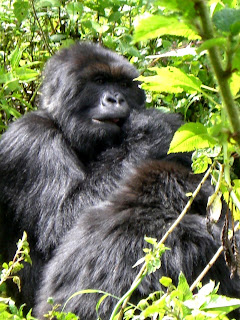
Our briefing had told us that we had to maintain a seven metre distance between us and them, but this rule does not seem to be strictly observed, at least not by the gorillas. The youngsters played around us, climbing trees and crashing down amongst the group, whilst the indulgent parents looked on, not interrupting their long meal (they eat some 30kg of vegetation each day) or their grooming. It looked like an easy, lazy existence, though I was surprised to see a couple of the young males beating their chests, King Kong style - yes, they really do that!
 There were four enormous silverbacks, a number of younger males, many females and quite a few youngsters. The guide later told us that we had seen 37 of the 39 gorillas in the Susa group - 5% of the total population of this endangered species!
Our hour in their presence passed far too quickly.
 Nyungwe Forest is the largest surviving patch of montane forest in Africa, home to 14 species of primate and 283 species of birds. I took three guided walks (the only way to visit) and saw several of each. It did feel a little surreal creeping through primary rainforest, dripping with mosses and giant tree ferns, in search of the Ruwenzori turaco (like some kind of intrepid naturalist), but the forest was beautiful, and we did indeed see the turaco plus several other beautiful and/or rare species of bird.
I suppose to a real twitcher the Grauer's rush warbler was the most thrilling sighting, found only in that region and amongst the rarest birds in Africa, but in fact it was a rather boring little brown thing, and I was much more excited by the commoner but beautiful bar-tailed trogon, with its blue chest, red belly, green back and wings and long black and white barred tail.

Also beautiful (I'm using that word too much, but it does apply rather a lot in Rwanda) was a troop of Angolan colobus monkeys - and I also saw blue monkeys and mountain monkeys during my searches for birds. I decided not to spend $50 on a chimp-tracking walk, as this could be up to eight hours of difficult walking/climbing/scrambling up and down steep and slippery mountainsides as the troop moves around so much. After all, I had the gorillas to look forward to in the Volcanoes National Park!
This park is a chain of five or six volcanoes, on the border with DR Congo and Uganda. Some 320 of the world's remaining 700 mountain gorillas live on the Rwandan side, and for $500 you can climb up with a guide and a couple of armed guards (protecting against poachers who kill the females and steal their babies for private zoos) to track one of the family groups and spend an hour with them.
I chose to track the Susa group - the biggest with 39 members but also usually the hardest to reach. Being low season, I did not have to fight for the privilege of tracking this group, which is often the most sought after, in fact there were only three of us doing the trek which was good news.
After an hour's drive we started our walk, which began with an hour or so up a steep-sided hill through farmers' fields. We were already at 2,600m (more than 3,000m by the time we reached the forest), and soon my heart was thudding and my leg muscles were screaming for oxygen. Thankfully there was no pressure to go quickly. When we got to the bamboo forest the slope lessened, but then we were faced with a new obstacle - stinging nettles! Vicious stinging nettles, powerful enough to sting through trekking trousers, and so many of them that they could not be avoided. However, we soon forgot about our stings as we heard crashing sounds nearby - the gorillas!!
My heart was thudding again, but this time with excitement. A lifelong ambition about to be realised. It's hard to convey the feelings I had when we actually saw the gorillas. They are ENORMOUS, and powerful, yet so gentle (and covered with the longest, softest-looking fur) and clearly no danger to us whatsoever.

Our briefing had told us that we had to maintain a seven metre distance between us and them, but this rule does not seem to be strictly observed, at least not by the gorillas. The youngsters played around us, climbing trees and crashing down amongst the group, whilst the indulgent parents looked on, not interrupting their long meal (they eat some 30kg of vegetation each day) or their grooming. It looked like an easy, lazy existence, though I was surprised to see a couple of the young males beating their chests, King Kong style - yes, they really do that!
 There were four enormous silverbacks, a number of younger males, many females and quite a few youngsters. The guide later told us that we had seen 37 of the 39 gorillas in the Susa group - 5% of the total population of this endangered species!
Our hour in their presence passed far too quickly.
In Memoriam

The legacy of the 1994 genocide still hangs heavy over Rwanda. 800,000 people killed in a 100-day frenzy of slaughter - I suppose you can't forget that overnight.
I was warned when I arrived not to ask people whether they are Hutu or Tutsi - they are all Rwandans now, with ethnic differences supposedly in the past. Indeed the Rwandans generally only talk about "one side" and "the other side", avoiding the use of those tribal names, but nevertheless they talk about the genocide a lot more than I expected.
Wouldn't you want to move on, and bury something like that in your history? But you turn on the radio or pick up a newspaper in Rwanda and it is all about the trials (escaped killers gradually being extradited back to Rwanda as they are discovered) and the process of reconciliation. Drive through the countryside and you see the prisoners (mostly the genocidaires, who were given up to 25 years in jail depending on the level of their involvement) doing community work in their pink uniforms. Even when I went to a small village as part of my work, one of the villagers pointed out the church, to tell me how many people were killed in there during the genocide (including his sister).
Indeed most towns seem to have genocide memorials - no-one is allowed to forget, even if it were possible to forget such horror.
I visited the National Memorial in Kigali. An incredibly well-presented display - narrative, photos, video testimony - takes you through the really quite unbelievable story, and small pictures on the walls of the central gallery commemorate some of the victims. At the end is the section which my guidebook warned would really hit home. It sounds overly sentimental, manipulative even, but yes, it did hit home. Several interconnected rooms display life-size photos of cute little Rwandan children - the last photos taken of them alive. Beneath are a few simple biographical details, for example:
FABIEN, 8
Favourite food: chocolate and chips
Best friend: his big sister
Died: smashed against a tree
I left in tears.
Murambi, on the other hand, is a very different kind of memorial. A former technical college on a hill near Gikongoro, it became a place of refuge for Tutsis in the early days of the genocide, some 50,000 gathering there from the region. Once there, however, the supplies of electricity, water and food were cut, and one night in April the Interahamwe came. Within two days most were dead, apart from those who escaped to a nearby church - and they were followed and killed the next day.
Four people survived, one of whom, Emmanuel, now works at the memorial showing round visitors, repeating that he lost his wife, children, everyone. "All finished" he kept saying, mournfully.
I knew what was on display, but nevertheless I gasped when he unlocked the first of many classrooms and I saw the dried, mummified remains of some of the men, women and children killed there. They put lime powder on the bodies which has preserved them (although also bleached them white), and bodies lie there in the positions in which they died.
 You can see the machete cuts in the heads, broken legs and ankles, but worst is the physical positions of some of them - cowering with arms trying to protect their heads, with screams frozen on their faces... It really is quite horrific.
Then when I thought I'd seen the worst, they led me outside to show where the French military had planted their flag during Operation Turquoise. This was the episode when France decided "something had to be done". By this time the genocide was almost over, as most Tutsis still in Rwanda were already dead, and those who had been living outside Rwanda (exiled to Uganda during previous ethnic violence), together with a few moderate Hutus, had returned in the form of an invading army (the RPF) which had already reached the capital and was looking close to taking the whole country. The French had already funded, armed and helped train the extremist Hutu Interahamwe militias, but now seeing the advance of the English-speaking Tutsis they decided to intervene, to protect their interests (the French language) in the region.
Operation Turquoise established a French-controlled buffer zone between the RPF and the retreating Hutus, supposedly to protect the latter from revenge. The effect was that the genocidaires escaped to DR Congo, from where they continued to launch attacks into Rwanda for some years after the war.
Emmanuel showed me where the Turquoise soldiers used to play volleyball - next to what had been an open mass grave full of victims of the massacre. He was not a fan of the French. Indeed few in Rwanda are (the irony being that English is now taking over from French as the country's main foreign language), and last year the president (who was head of the RPF when it invaded and ended the genocide) told the French to close their embassy and leave after they accused him of bearing responsibility for the genocide.
Conakry
I had to do a separate entry on Conakry as it is so different from the Guinea I saw in the forest region.
I went out of my hotel to search (in vain) for somewhere showing the Newcastle v Man Utd match, found myself immediately in the middle of what seemed to be just a sprawling slum. The buildings mostly single-storied (and low enough for anyone taller than me to probably need to stoop to enter), crumbling, with patched-up corrugated iron roofs – and swarming with people. Everywhere there are people, playing football, cooking, eating, washing, laying out their laundry on a spare patch of wall (or road). It was as if I had somehow walked into the inside of people’s homes.
Later I found out why. So many people inhabit most of the houses that they occupy them on a rotational basis: while one goes outside into the street to wash and cook, the next takes his turn to sleep in the bed. The effect is that people mostly live in the streets. So walking about, as a foreigner, is very odd, giving the feeling that you are intruding into people’s private lives just by being there – although I felt no hostility.
I also stumbled upon a little “sub-slum”, it seemed, for the disabled. It was outside a big building with railings out front, and there was so much stuff slung over the railings that at first I thought I was in some sort of market. But as I tried to work out what was for sale I realised that I was looking at people’s bedrooms. Mattresses, pillows, towels, etc – with the usual washing and cooking equipment piled on the pavement in front.
I also noticed quite a few wheelchairs and crutches around, and then realised that the people lounging on the mats, and those moving around, weren’t quite ‘normal’. They were shuffling, and limping, and the wrong size and shape, with limbs missing, or twisted and withered. All of this was out of the corners of my eyes – I so wanted to LOOK. But I knew that if I did I would have to pay, and there were just too many people there to start handing out money, no matter how shocking their circumstances.
One part of the city is different – that is where you find the presidential palace, the government ministries and the cathedral. Not an area of obvious wealth (I never found the quarter that houses the government ministers and their families and friends, whom stories suggest have an awful lot of money), but one devoid of life. No one lives on these streets, the army would soon stop that, with the result that it feels like a ghost town.
 As with the rest of the city, everything is crumbling and mouldy, and scattered with bits of rubble and litter, but with no people to give it life it has the air of being abandoned. A couple of parked cars – typically rusty and decrepit – look as though they have sat there for years.
It is only when I get out my camera and take a photograph that another human being appears – some sort of security guard, who claims to be a policeman and asks me if I have a photography permit. I laugh and tell him they’re not necessary any more, that Guinea is a more free country now, and I offer my hand in greeting. He relents, and tells me he will let me go “because you are a woman”, before moving on to the more usual subject of whether I am married and whether he can visit me in my hotel. I tell him I am flying home to Dakar that evening, where my husband will be waiting for me, but that I will pass along this street to say hello next time I am in Conakry…
I went out of my hotel to search (in vain) for somewhere showing the Newcastle v Man Utd match, found myself immediately in the middle of what seemed to be just a sprawling slum. The buildings mostly single-storied (and low enough for anyone taller than me to probably need to stoop to enter), crumbling, with patched-up corrugated iron roofs – and swarming with people. Everywhere there are people, playing football, cooking, eating, washing, laying out their laundry on a spare patch of wall (or road). It was as if I had somehow walked into the inside of people’s homes.
Later I found out why. So many people inhabit most of the houses that they occupy them on a rotational basis: while one goes outside into the street to wash and cook, the next takes his turn to sleep in the bed. The effect is that people mostly live in the streets. So walking about, as a foreigner, is very odd, giving the feeling that you are intruding into people’s private lives just by being there – although I felt no hostility.
I also stumbled upon a little “sub-slum”, it seemed, for the disabled. It was outside a big building with railings out front, and there was so much stuff slung over the railings that at first I thought I was in some sort of market. But as I tried to work out what was for sale I realised that I was looking at people’s bedrooms. Mattresses, pillows, towels, etc – with the usual washing and cooking equipment piled on the pavement in front.
I also noticed quite a few wheelchairs and crutches around, and then realised that the people lounging on the mats, and those moving around, weren’t quite ‘normal’. They were shuffling, and limping, and the wrong size and shape, with limbs missing, or twisted and withered. All of this was out of the corners of my eyes – I so wanted to LOOK. But I knew that if I did I would have to pay, and there were just too many people there to start handing out money, no matter how shocking their circumstances.
One part of the city is different – that is where you find the presidential palace, the government ministries and the cathedral. Not an area of obvious wealth (I never found the quarter that houses the government ministers and their families and friends, whom stories suggest have an awful lot of money), but one devoid of life. No one lives on these streets, the army would soon stop that, with the result that it feels like a ghost town.
 As with the rest of the city, everything is crumbling and mouldy, and scattered with bits of rubble and litter, but with no people to give it life it has the air of being abandoned. A couple of parked cars – typically rusty and decrepit – look as though they have sat there for years.
It is only when I get out my camera and take a photograph that another human being appears – some sort of security guard, who claims to be a policeman and asks me if I have a photography permit. I laugh and tell him they’re not necessary any more, that Guinea is a more free country now, and I offer my hand in greeting. He relents, and tells me he will let me go “because you are a woman”, before moving on to the more usual subject of whether I am married and whether he can visit me in my hotel. I tell him I am flying home to Dakar that evening, where my husband will be waiting for me, but that I will pass along this street to say hello next time I am in Conakry…
Guinea Forestière

Lots of ups and downs in Guinea (though no teapot trees as yet).
The ups?
- Driving through the few remaining patches of primary tropical forest, the type where mankind has not shaped or even altered the landscape, where you feel very much like an insignificant visitor to a powerful natural world.
- A weekend spent with a local community in their village – eating, drinking, sleeping and washing the way the villagers do, and experiencing their wonderful hospitality.
- Getting to watch the Man Utd - Arsenal FA Cup game (which my team won embarrassingly easily) despite being in a town with seemingly no facilities at all.
The downs?
- ‘Showering’ from the bucket of cold water left outside my hotel room in the mornings.
- Tripping over on the way back from work one evening (no pavements, no streetlights, no moonlight – and my torch left in the hotel).
- My second bout of ‘Guinea belly’, at the same time as a heavy cold, a mild temperature, a headache, and lots of work to get through.
– The Harmattan. Yes I know I’ve written about this before, but I’ve not experienced it quite like this: blotting out the landscape in a white haze, burning your throat, constricting your breathing as if something had been wrapped too tightly around your ribs, and with a constant taste of dust in the mouth.
- Sir Alex deciding to rest Ronaldo the one time I get to see a match.
Lying on my bed in Gueckedou, looking up at the low energy light bulb dangling from a few wires at the end of the broken fluorescent light casing (hotel generator switched on for a few hours), and listening to the rain hammering down on the corrugated iron roof above, I had another of those “what on earth am I doing here?” moments. They come every so often, as I find myself shaking my head in wonder or disbelief at some of the strange places or surreal situations I find myself in these days. (I had another during the eight-hour drive between Kissidougou and Conakry, when the driver changed the music from Guinean griots to Barry White singing “My first, my last, my everything”)
 We used to have our main Guinea office in Gueckedou, until rebels (mostly child soldiers) came across the border from Sierra Leone in 2000 and started killing people. The Guinean army responded by dropping bombs on the town and many of the buildings were destroyed (and many people killed). The shells of those buildings are mostly still there, as the owners could not afford to repair or rebuild them, and the town has grown up again around them.
Now I am in N’Zerekore, in another strange place. Although some 14 hours’ drive from the capital Conakry (during the three months of the dry season – sometimes inaccessible during the rains), and in fact closer to the capitals of Liberia, Sierra Leone, the Ivory Coast and Mali than to the capital of Guinea, this town boasts a ‘luxury’ hotel. I say ‘luxury’ because it is still nicely designed, and modern, and clean, and amazingly it still has a functioning swimming pool. However the new Chinese management team seem determined to wring as much profit as they can from the place so many of the rooms no longer have running water, the generator is only on for a few hours a day, television sets have been removed from the rooms to save on repair costs and the advertised satellite TV (for the one – 12” – TV available to guests in the bar) now refers only to the dish on the roof as the subscription to the satellite channels has been cancelled.
The restaurant menu boasts such temptations as guacamole, spaghetti in a cream and mushroom sauce, and bottles of red wine, but in fact none of these things are available so it is back to chicken or beef with rice or chips and a bottle of water to wash it down.
Strange to think that this country has gold, diamonds and one third of the world’s aluminium ore, yet has no telephone lines (and very poor mobile connectivity), no mains electricity and no public water supply in most of the country. Soon it will have no surfaced roads either, as a lack of maintenance (and poor standards of construction as most of the funds are siphoned off through corruption) means that the rains are washing away the surface to reveal the hard red lateritic soil beneath. You really do feel a long way away from the developed world here.

The other ‘down’ I suppose was my visit to Mount Nimba. This mountain, on the border with the Ivory Coast, is a World Heritage Biosphere Reserve, set up to conserve its wildlife – the chimpanzees, but more importantly a protected species, the ‘crapeau geant’. That is French for giant toad, but in fact the creature in question is a small frog – unique, according to the locals, because the females breast-feed their young. I’m not sure that I actually believe this, but I was certainly keen to see the birds and the chimps, so was very pleased when the office here managed to arrange transport for me.
However when we got to the park entrance on the Sunday morning, the guards on duty would not let us in. Apparently access to the park is now closed by order of the Societe des Mines de Fer de Guinea – an iron-ore mining company that has just started operations inside the park. So much for conservation.

Above is a photo of an amulet, from a collection at the Kissidougou museum, worn by one of the rebels in 2000 - some cream-coloured cloth with some bits of wool stuck on. Many of the rebels believed that wearing amulets like this would protect them against bullets.
Subscribe to:
Posts (Atom)


 Posts
Posts

