the end (probably) of louiseinsenegal

So I have made the decision to try out the nomadic lifestyle, saying goodbye to Senegal.

OK, my temporary residence can still be renewed if I visit the Police des Etrangers in Dakar before 2 January 2023, but the likelihood of that is very low.  I'm sad, as I liked so much about Senegal - the climate, the music, my local beachside bar with its resident pelican, the baobab juice ... and I should have liked the relatively cheap prices, had I realised that the UK had got so much more expensive over the last couple of years.  But the status of older, single white people just made it too uncomfortable a place to live, always having to fend off the young men, and there was also the related constant intrusion of money concerns with other local friends, the reality being that every Senegalese person who has mattered to me, has ended up owing me money, none of which I shall ever get back.

Practicalities might have made permanent settlement there difficult, too.  Medical cover, for example, could become an issue as I get older.  & I have absolutely no idea as to the tax implications (if any?) of my temporary residency ever becoming permanent. 

In any case, I want to see the world, and Senegal is not a good base from which to do that.  So, whilst there is plenty I shall miss, it is time to move forward.

On to louiseinlimbo.blogspot.com !  (or, as I now find it listed as, louiseinlotsofdifferentplaces.blogspot.co.uk)

delaying the start of my new life

The point of returning to London was to do a few administrative tasks before setting out on the next phase of my life - but an unexpected email threw me off-course.  It seems that a couple of colleagues I'd worked with some years ago had recommended me to the Executive Director of a small US-based NGO as the ideal person to go to Ghana to investigate a possible fraud.  Difficult not to be flattered by such an approach, I couldn't refuse.  So I was off to Ghana!!

They put me in a nicer hotel than I expected, but there was so much work to get through that I only found time to use the swimming pool once and didn't even find the gym, nor turn on the TV.  But I did accept an offer from one of the staff there of a two-hour tour of the highlights of Accra, having realised that on all my previous visits to the country, whilst I'd been along the coast to see the slave forts, and into the interior to see some birds, I had not properly visited the capital city.  Not that Accra has any outstanding tourist sites, but I got to see Independence Square and the nearby Black Star Gate (commissioned by the first post-independence president in honour of Queen Elizabeth II), to be driven past the parliament, theatre, etc, and through the more lively and interesting neighbourhoods of Jamestown and Chorkor.

But I also had to visit some of the partners they work with, one of which was on the shores of Lake Volta - another part of the country I hadn't been to before, and a nine-hour trip including the ferry across the lake, so plenty of time to look out of the window at the countryside but also some (final?) views of the typical life of the region, as we passed through villages and towns along the route.  Of course there were birds around too, and a few baboons on the road at one point.

An unexpected event took place, however, whilst I was staying out in the town beside the lake.  I heard a shout outside and the sound of someone running.  Through my window I saw someone run past with a fire extinguisher in their hand.  I poked my head out of the door to see smoke coming from the roof of the executive rooms, a few doors down from my room, so I grabbed my camera...

Within a frighteningly short time, that smoking roof had turned into a raging inferno in the hotel room below.  The fire service were called, and hotel staff also ran around throwing buckets of water at the building, but by the time the fire was out, three rooms had been gutted, the roof burnt out, and the belongings of one guest completely destroyed.  It was shocking to see how quickly a fire could spread.

The colleague who'd driven me there was convinced that I must have found incriminating evidence at the partner's offices, and they were trying to burn the evidence I'd written up in my report, but in fact I'd found nothing wrong at that partner and the culprit was far more likely to have been linked to the comings and goings of the power supply during the time we were staying there.

In any case it didn't stop me completing the work - and thankfully, with all of the chaos affecting airports during this period, I was able to fly home as scheduled and my luggage arrived back in London only three hours after I did, on the next flight.


in London for the Jubilee

Whilst it wasn't my reason for being in London, I was happy that my visit coincided with the Queen's Platinum Jubilee weekend.  In my twenty years of living in London I never once saw the Trooping of the Colour, and the jubilee seemed like the perfect time.

So on the Thursday morning I wandered out to the tube, only to hear the announcement that Green Park station was closed due to over-crowding ... a warning as to what was to come.  Enormous crowds.  Everybody in good humour, fortunately - no pushing, no complaining, no risk of a stampede - but what seemed like millions of people packed tightly along the streets.  It became clear that there was no way I would get anywhere near The Mall, nor into Green Park where there were apparently screens showing the events (people had been camping out overnight to get their slots), but I managed to get a slot three rows back from the barriers on Horse Guard's Parade.  So I wouldn't see the Queen, nor the actual ceremony, but I could see other members of the royal family setting off in open-top coaches and a few guys in fancy uniforms.  Camilla and Kate waved in our direction but there was no chance of a photographic souvenir with all of the waving hands and mobile phones held up in front of me.  A little while later we had the fly-past, however, and no-one could block my view of that!

I didn't bother making any attempt to see the Saturday evening concert in front of Buckingham Palace - clearly the crowds would be just as big again - but on Sunday I finally chose to miss the local street party (free food and drink!!) and try instead to see the pageant.  Which was not too difficult, as I found a place in The Mall with a great view, and the only blocks to photography were the policeman standing guard and the waving arms of the man standing next to me - he'd been there since 6am to ensure a good spot, and was determined to whoop, holler and wave at all of the participants.  It was good of him - nicer for the participants to be cheered and waved at than just to face a sea of mobile phone cameras - but slightly irritating at times!

It was a great show - particularly, for me, all of the uniformed men and women from different regiments (representatives from all countries which have the Queen as head of state) who started things off - and this part included the State Gold Coach in the picture above, with a hologram of a younger Queen waving from the window, as the coach (dating from 1762) has no suspension and apparently is too uncomfortable for a 96-year-old woman to ride in for three miles.


What followed that was a bit strange, although quintessentially English in its quirkiness.  A showcase of British culture during her reign, from open-top buses with past and present stars (those I recognised included Tony Blackburn, Esther Rantzen, Chris Tarrant, Mo Farah and Chris Wickes) waving to the crowds, people riding the various forms of transport from the 70 years of her reign (different bicycles, mopeds, classic cars ... even a group jumping along on spacehoppers), representations of her favourite animals (corgis and horses being the obvious ones, but also mute swans - maybe many people don't know that all mute swans in British waters officially belong to the Queen! - and some from Commonwealth countries including zebras, gazelles and giraffes), some cultural icons such as Basil Brush, wombles and Paddington Bear, and a few seemingly random scenarios such as an Indian wedding.  Some a bit amateurish when compared to the great carnivals around the world but all great fun, and I was very happy to have been in London during this period.


moving on from Senegal

As per my last post, events kind of pushed me into an earlier departure from Senegal than I had planned for.  It was a difficult last few weeks, in part from the practical difficulties of living in a friend's front room, in part from having to say goodbye to people when I wasn't ready to, and also due to my inability to make the most of my last few weeks as Ramadan meant there were no concerts taking place and I was in any case spending a great deal of time trying to reduce my possessions to the minimum whilst at the same time trying to chase my former flatmate to recover some possessions that had been taken from the street and put in storage.  Ideally I would have spent a week or so in the south of the country re-visiting the initiation ceremonies, and perhaps some time down on the coast south of Dakar, but I was too busy getting things done as well as 'being there' for the friend I stayed with who is currently going through a hard time.


I was, however, even more aware than usual of the little things one takes for granted in Dakar that I knew I would miss once I left.  The neighbourhood cattle, for example - apparently protected by some form of magic so nobody takes one - but nobody feeds them either so they wander from one pile of rubbish to the next as they make their way round and round our little part of town.  Sometimes one gets left behind and moos pitifully until the others come to find him again.  I got quite fond of them.

I also knew I'd be leaving behind the many horses and carts that ply the streets, the horses usually done up with decorated bridles (often covered with cowrie shells) but also some with coloured leather tassels, glittery pom poms - and a recent fashion for incorporating a teddy bear somewhere amongst all the decoration.  I asked one of the owners what the teddy was for and he just told me it was 'the driver'! 

Of course I knew I'd miss some of the local food and drink, so made sure to eat a mango for my breakfast every day and to drink as many glasses of baobab juice as I could get my hands on.

I didn't really question myself as to why I was leaving.  Despite all the things I would miss - and some of the people there - I would, as a single, childfree older white woman, always be an outsider, plus it wasn't a great base for someone who enjoys travelling as the flights from Dakar are very expensive.

So I packed as much as I could into one rucksack and one suitcase, sold or gave away the rest, said goodbye to my friends and bought myself a flight back to the UK, where I planned to get a few administrative things done before setting off into a different part of the world.

eviction


I was just starting the last week of my assignment in Mali when I received an awful message on the WhatsApp group of my flatshare in Dakar.  There are four flatmates: a Senegalese lady who rents the entire flat from the owner, and three of us who have individual contracts with her - the sub-tenants.  So we each pay her rent on a monthly basis for our rooms and use of shared facilities, and she pays rent to the owner.

Or at least she should do.  It turns out that she hasn't been paying it for some months, perhaps as long as six months, and so the owner turned up on Monday last week with some strong men, forced entry, and removed all of the contents of the flat.  From curtains and furniture to food and clothes - all of which was dumped in the street outside.

Thankfully a friend of mine in Dakar was on hand to take a taxi to my building - above her photograph through the from window of the taxi - to try to gather what she could of my possessions, to be stored in her flat.  I owe her a lot...

It turns out that during my absence the situation in the flat had been worsening, with days with no electricity, or no wifi, because she wasn't paying any of the bills.  So my two fellow sub-tenants had each given notice, and neither had paid their final month's rent (so as to recover their one-month deposits), leaving the prime tenant with no funds to pay the rent - although how relevant this is I don't really know, given that she hasn't been paying it for some months.  During this time she has been unemployed, and there have been problems with her ex-boyfriend who is apparently a former drug addict who stole money from her, and she was mugged in January, losing her identity papers and her phone.  Or at least, that is the story she told me but I cannot say I'm 100% sure that she was telling the truth.

Now I am back in Dakar, sleeping on the settee in my friend's one-bedroom flat.  Going through the stuff she recovered, throwing out the things that got broken and trying to separate the rest between things I really want to keep and things I can get rid of now that I do not have a home here.  & having to accept that there is no realistic hope of recovering the rent I'd paid until the end of the month nor of the one-month's rent I'd paid as deposit.

Deposits, which are often the equivalent of two months' rent, are rarely returned here, and so I'm not keen to seek another flatshare for what would only be a relatively short time.  I had in any case planned to leave Senegal in July, to move on to some other part of the world - Covid and wars allowing - so I am now trying to look forward rather than backward and to prepare for an earlier departure rather than mourn what I have lost.

making the most of the little freedom I have


The security restrictions have not lightened, so I am still home- and office-bound, apart from a few short walks around the neighbourhood with my flatmate, enabling me to grab the above photo of an Abyssinian Roller (there's a pair that fly around but won't settle anywhere close other than on the top of lamp posts, but finally I was able to zoom in on this one) and the one below of a tranquil river view.

... which I must say does not capture Bamako at all well, as 98% of the city is anything but tranquil!  Although I can't go out, I can of course look through the car window as we travel between home and office (plus a couple of trips into town to meet suppliers, as part of the project I'm working on), and it is fascinating to watch the city in action.

It is an interesting mix of urban and rural, as people take advantage of any patch of unused land to grow fruit or vegetables, and livestock is everywhere: goats being dragged along or huddled in groups waiting to be bought, cows wandering around looking for food - seemingly totally unafraid of the traffic, which has to give way when one decides to wander across the street - donkeys hauling carts along, and the odd horse tethered to a post too.  I still haven't got used to the sight of the animals on the roads or walking along next to a shop, or an industrial plant.

Sadly I have got used to how dirty the place is.  It is dusty, of course, as the dust (fine sand) particles blow in from the desert, but it is also full of broken down vehicles and other equipment, and with rubbish, especially empty plastic bags and bottles, strewn everywhere.

I don't want to give a bad impression of this country I love so much, but really, the capital city is not its strongest point, aesthetically.

Bogo Ja festival

My visit to the Arch of Kamadjan was only part of my day out from Bamako.  I chose that particular day because it was the weekend of the Bogo Ja Festival in Siby - Bogo meaning mud, and Ja I think meaning sun - celebrating the painting by many of the local women of their houses, granaries, wells, etc in various colours obtained from the local soil.  So the village was looking very colourful - mostly in abstract patterns as above, but some real artistic talent was on show on some houses!

As well as all of the colourful houses to look at, there were activities taking place in the centre of the town - women with painted faces and limbs dancing to some drumming, live local music with calabash, djembes, koras and singing, and a troop of puppeteers in from the capital to display their amazing ability not just to make the regular-sized puppets dance, but also with giant-sized puppets.  These latter they wore out into the streets of the town, notwithstanding that it was market day and so the main road was jam-packed already with buses, vans, taxis, motorbikes, horse-drawn carts and any other form of transport that people could find.  Their drummers bravely set out in front of them, and the people and vehicles moved aside as best they could, everyone with big smiles on their faces.


On my first day in the office, in my security briefing, I had told the Security Manager that I wanted to go to Siby, and he had said "I think that could be arranged".  However, I managed to upset them a week before the Siby festival by asking permission to go out to a concert one evening; I was following the rules I'd been given by asking permission, but rather than saying "no", they decided to give VERY grudging permission (so grudging that I didn't actually go to the concert) and report back to the project manager in the UK that I didn't want to follow the rules!  I feared that if I raised the Siby outing at this stage, they would at best say no, at worst report back to the UK again.  So I interpreted their initial response to mean that I could arrange to go to Siby (without their further involvement...), and I did so, taking care to use a 'safe' taxi driver (one they had recommended) and to be back home well before dark.  Thankfully I didn't break my leg ascending the arch or get kidnapped by rebels, and nor did we have an accident on the road (all too common here - we saw the aftermath of four such accidents that day).  But clearly given their attitude towards security - particularly for white visitors who are at higher risk of kidnap - this will be my only outing during my time working here.

a day out to visit the Arch of Kamadjan


My time in Mali is passing quickly, even though I am pretty much restricted to the Bamako office and my accommodation (now sharing an apartment with a colleague so as to save costs).  However I have managed to get one day out, when I visited the small town of Siby, some 45km south-west of Bamako.

It is well-known amongst travellers for the Kamadjan Arch which is near the village, and I started my day with a walk through the fields to the viewpoint from where I took the picture above.  Then we started an ascent, via the 'consultation cave' (where the elders come to ask advice from resident spirits who will speak to them in the early hours of the morning) - here a picture looking out from the cave - and from there up to a point underneath the arch.

It seemed as though that was the endpoint of the walk, but then the guide mentioned that it was possible to get on to the top of the arch although not everyone would make it up.  Something between a walk and a climb.  I asked if he thought I'd make it and he said maybe not ... but I said we should start the ascent, on the understanding that I could turn back at any point where it got too difficult.

There were some tricky bits - "put your left foot here", he said, "and your right foot on this rock here..." - but my legs weren't long enough to reach - so I did get lifted, pushed, and pulled a few times!  My taxi driver had come with us, having never visited the arch before, but on one of the steeper parts where you had to hold on with both hands he gave up, said he was getting vertigo and would wait for us to come back down.  But I made it all the way up (and back down)!  It was worth it in part for the sense of accomplishment, and in part for the great views.

Seeing a little, but not much, of Bamako


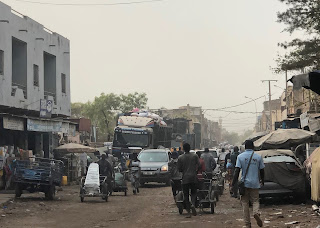
So, thrust back into the world of work, I have not had time to post an update here.  For security reasons they put us in a relatively good (ie expensive) hotel, and when costing an NGO $150 a night plus food, in addition to my consultancy fee, I really feel that I have to work hard; indeed the whole team has been bringing files back to the hotel to work on in the evening and at weekends.  Once we fight our way through the traffic, that is.  This is a typical street scene at this dusty time of year taken through the car window.


 With time out - for me - to get in a few laps of the rather large hotel swimming pool on Saturdays and Sundays!  Nice to get to fill up on the buffet breakfasts too - always my favourite meal of the day when staying at a decent hotel, although the sanctions on Mali are affecting the hotel: first the raisins ran out, then the dried apricots, then the cheese....

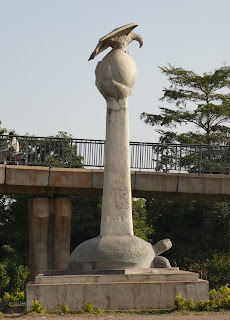
Security restrictions by my employer here are tight, but I was able to take a quick walk around the block by the hotel, and snap a picture of one of the two pillars representing Nascent Democracy.  Apparently the tortoise at the base, representing patience and wisdom, is supporting the arms and hands of the Malian people, which hold an egg in the process of hatching - being the birth of modern democracy, under the watchful eye and vigilence of the Imperial Eagle.  I have no idea when these were erected, but clearly some time before the coup d'etat in 2020...  They seem rather ironic at the moment, especially as there is a large poster of the transitional (coup) leader who has said he cannot organise elections before 2027!

I've also been learning a few basic facts about the country, such as the fact that its name comes from the Bambara word for hippopotamus - and the name of the capital comes from the Bambara words for crocodile (bamba) and river.  For this reason there are statues around the place of both hippos and crocodiles, including the stone crocodile above, located within the monument to the first president Modibo Keita (being refurbished, hence the lack of water in the pool).

Now they've moved us out of the hotel so as to save some money, into apartments used by secondees here in an upmarket part of town.  Upmarket meaning that we are surrounded by some pretty impressive large houses, but it is still infested with mosquitoes, and security restrictions mean that I am only allowed to set foot outside the apartment block if I can persuade the Togolese lady I'm sharing with to go out for a walk with me, as the office don't want the risk of our going out unaccompanied.

back to work?

As I was packing up my stuff in late November ready for my trip to Kenya and Saudi Arabia, I received a rather surprising message from a former colleague - someone quite senior at the NGO I used to work for.  Was I still living in West Africa?  Was I working, or did I have time available?  & would I be interested in a consultancy project in Mali for three months starting in the New Year??

Having been thrust rather unexpectedly into an earlier retirement than planned (or rather, having never previously thought about when I might retire, and suddenly finding myself faced with a fait accompli!), with Covid and the politics generally discouraging me from an early return to the UK and Covid also complicating any attempts to set off on a slow backpacking trip around the world, I had settled rather too easily into life in Dakar, albeit at a level of budget that meant it was not always comfortable.  So this did not really feel like an opportunity I could turn down - the chance to earn some money, whilst not really missing out on any alternative during that time period.  With the added attraction, in a way, that it was my love of Mali that led to my being told about the job in Dakar back in 2006, and whilst the capital Bamako (where the project takes place) is not part of my reason for loving the country so much, nevertheless it seemed fitting to end my work in the region in Mali.

So we negotiated contract terms and I signed up to fly to Bamako on 10 January, for a three-month contract.  I got a visa sorted out, packed my suitcase, and on 9 January I went along to the Covid testing place to get my PCR test done, all ready to go.

Only it wasn't to be that simple.  The email and Whatsapp message came through late in the afternoon, to tell me that the analysis of my test result was 'inconclusive' and they would have to do it again.  then around an hour later, news filtered out that ECOWAS (the Economic Organisation of West African States) were so unhappy about the Malian coup leaders putting off the promised election that they had slapped sanctions on Mali with immediate effect - including closure of all land and air borders.  So even if the re-analysis of my Covid test gave the result I was expecting, there would be no flight from Dakar to Bamako the next day, nor indeed for the foreseeable future!

Cue frantic running around in our NGO offices to try to find a way of getting my colleague and I to Bamako, with the eventual solution being a very long route via Istanbul a couple of days later.  However at around midday, my updated result came through from the lab, and I found that I was Covid-positive.  A big surprise, as I am triple-vaccinated and was not experiencing any symptoms of infection ... or at least, I hadn't thought I was, but once I knew my positive status I re-evaluated those sneezes from earlier in January and related runny nose 'due to the dust'.  My flatmate was also sneezing in response to the dust cloud, but got tested following my result and of course found that she was also positive.

Two tests later and I finally got the negative result I needed, and a ticket for a long flight to Istanbul, 15 hours there in transit, and another long flight back to Bamako, and on 1 February I set off for the airport - and whilst the car broke down en route, I still made my flight and arrived safe but tired in Mali.  As the project pays me a daily rate I was disappointed to have missed three weeks of pay, but it seems that the work has been progressing slowly and they will probably still want three months of my time, possibly even four months.

& by the most surreal coincidence, on the morning of 1 February I received a message from someone who used to work at my NGO many years ago, now at a different NGO in a different part of the world and seeing that they need some advice and input from someone with my experience; he asked if I would be sufficiently interested in the possibility of a consultancy project there that he could give my contact details to the board of directors.  So it really is not feeling as though the world of work is yet ready to give me up to retirement!

general musing on life

Having been largely grounded in Dakar since my job ended last year, I've had time to reflect generally on life.  Perhaps not always a good thing to do, but in my case I feel I have lived a full and rewarding life, for which I am extremely grateful.

I worry sometimes that I am wasting some of it by sitting around in Dakar (like most people I know of my age, I have become more aware of time passing quickly, and of the fact that it will run out!), but on the other hand it is a pleasant place to be and is not costing me much money (less than I earn in rent on my flat back in London).  Plus I know that I am a support for two friends there going through difficult times - and sometimes little things happen that make me smile.

Like last week, I decided to walk down to an ocean-side bar/cafe, and then home via the supermarket.  On the way there, a horse and cart - a reasonably common sight in Dakar - went past me, and the man operating it turned towards me and beckoned to the cart, offering me a lift.  I initially declined, but he offered again and so I climbed on, and travelled the rest of the way to the cafe on the back of his cart, being smiled/laughed at by the occupants of the passing cars.  He dropped me at my destination, having not asked for either money or my phone number; in return, I did not ask to take a photo.  Then on the way home from the supermarket, a large, black 4x4 purred to a halt beside me, and the driver asked if I'd like a lift to somewhere further along the road - again, he asked for nothing in return.

Then the next day, I went out to my usual Friday afternoon hangout, having not been for the previous few weeks, and for some reason I was plied with drink by friends present there - and two glasses of baobab juice and two of Cote de Rhone later, I had to state very firmly that I did not need someone to give me change for the bus home!!  I also went away with an invitation to visit the house and meet the family from one person there - this from a place where people meet but mostly discuss impersonal stuff like religion and politics, so an invitation to peronalise things is quite meaningful.

further into Saudi Arabia

After the group tour, I had opted to stay on in Saudi Arabia for a few more days, with a friend, so see a few sites in the Asir Mountains region.  I wish I had added more time so as to relax a little in Jeddah where the group made only a fleeting visit, but we had to make the most of the days we had, so we took a taxi to the hire car office that the hotel told us was open.  One of the most frustrating things about Saudi was that places (offices, restaurants, museums ...) were closed, for no obvious reason, for much of the time, and this was no exception.  But once again the Saudi hospitality (or curiosity about foreigners?) was forthcoming, and a man who saw us looking despairingly into the closed windows of the office offered to help, and drove us for twenty minutes to another car hire office which he knew would be open.

So finally we set out for the south, the first day being just a LONG drive along the (almost) coast road - flat and fairly featureless, with just one or two camels to keep me amused.  But on the second day we turned into the mountain area.  Where the first surprise was the sight of baboons!  There were hundreds of them, swarming around rubbish bins and hanging around any lookout stops along the road, where they scavenged for food.  Not very friendly (one irritated male ran over and smacked my foot when I did something that annoyed him), but quite photogenic!

The mountains were fairly bare and rocky, and dotted with old watch-towers and other buildings constructed from the local dark stone with white quartz decoration above the windows and sometimes along the roof line.  It was sad to see so many of them crumbling, but there is a national programme that has allocated money for preservation of the heritage, and the village of Rijal Alma is one of the best.

We also stopped to explore a few of the abandoned buildings along the route, including these below where you can also see the other building style - layers of mud separated by rows of slate to protect the building from rain - more usually found in the valleys.  The roofs had mostly collapsed, and none of those we were able to see into had any of the traditional brightly-painted wall coverings remaining.


We also viewed the heritage village of Thee Ain - a beautiful spot in the late afternoon light, but over-restored so that from a closer viewpoint you could see that everything was cemented together.  The interiors still looked real but the precise, cemented joins of the exteriors made it feel like a film set rather than an authentic old village.

To get around this region, we were mostly travelling on Highway 15, an impressive bit of engineering as it traverses the high mountain passes.  The road, which runs from Mecca down into Yemen, was built (in the 1960s) by Osama Bin Laden's father - and twelve of the fifteen 9/11 hijackers were recruited from the towns and villages along this route!  As obvious non-Muslim foreigners we didn't encounter any hostility, however - and as noted in my previous post, the cultural environment in the country is changing enormously now.

Not changing so much that we were tempted into Mecca, though.  We accidentally followed one of the Muslims Only lanes as we approached the city, and so drove through on the inner rather than outer ringroad, but we did not take any of the turnings to Al-Masjid al Haram, with their pictures of the kaaba on the signs.  Apparently some independent travellers have been right into the city, and up to the outside of the mosque, but as far as we know it is technically still forbidden, and the rewards to me don't seem to outweigh either the risks nor the lack of respect to our host country that such a visit would have involved.  We could in any case clearly see the enormous Abraj Al-Bait clock tower (currently the fourth tallest building in the world).

Unfortunately no time at the end of the trip to see more of Jeddah, just time to return the car, get something to eat, and start the long flight home.

a tour of Saudi Arabia


Saudi Arabia opened its doors to tourists a couple of years ago, and I was quick to sign up to a tour.  Then it was postponed because of the pandemic but finally, a year later than planned, I was in Saudi Arabia - for a ten-day organised tour, followed by four free days.

I don't really know where to start with this post, to be honest, as it was such an enjoyable and fascinating visit in so many different ways, in particular for the scenery (I love deserts), the visual reminders of the history (Nabatean tombs, such as those at Jabal AlAhmar in the pic above, as well as architectural reminders of the Ottoman period, and the Yemeni-style old buildings in the mountains of the south), the camels, and finally the window onto a country undergoing MASSIVE change.  This latter was apparent physically (the construction - roads, railways, metros and buildings) as well as socially (women driving, women not fully covered, a few couples holidng hands in public, a public live music performance...).  The Crown Prince recognises that the oil era will end, so the money they currently have is being spent on adding/upgrading infrastructure (also financed by the fairly recent introduction of income tax, currently at 15%), whilst an enormous effort is being made to attract visitors, presumably with tourism seen as an important future revenue stream.  The social revolution in the 'freeing' of women supports the latter, as does a focus on international events.  Just before I arrived in the country there was a Grand Prix held in the streets of Jeddah, as I left there was an international film and arts festival taking place there, as well as a 'rave festival' near Riyadh.  Yes, really - men and women dancing to electronic dance music and, according to a report I heard, clear evidence of both alcohol and drugs there (although both of those currently remain illegal).  A Saudi there told me that most Saudis he knows would put up with a hundred Khashoggis if it means they will be able to go and have a drink in a bar.  Obviously I'm not supporting the murder of journalists - nor any kind of suppression of protest, as is the norm still in Saudi - but the Crown Prince and the change he is trying to bring about is popular - and the extent of change is impressive.

Of course there must be a proportion of the population who were happy with the conservative lifestyle they are used to, and still most women are fully covered, for example - with the niqab as well as the abaya even though the niqab was never obligatory.  It was interesting though to experience the extent of the welcome we experienced as tourists, with complete strangers waving to us as they drove past, inviting us into their home for coffee and dates, and countless women beaming with happiness when I smiled at them, making the heart symbol at me with their hands given their inability to express what they were feeling in words.
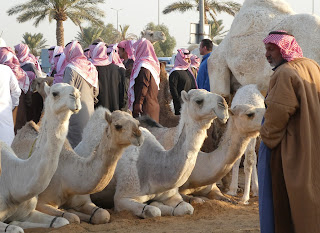
Anyway - perhaps I should mention some of the more 'standard' tourist highlights that I enjoyed there ... so first of all, the camels!  We went to Buraydah camel market - the largest in the world - to observe the trading as well as being real tourists with the opportunity some of us took to feed one man's camels.  I have no idea how many camels are there on a typical day, but there were baby and adult camels, there were white, sandy-coloured and dark brown camels, and a small number of smartly attired camels.  There were also plenty of trucks with cranes and winches, with protesting camels being lifted up into the air and into the trucks of buyers.

The beautiful desert 'countryside' was also well stocked with camels - some seemingly wild, but all, apparently, with their (mostly Sudanese) camel herder somewhere around.

Then, as I mentioned above, there were the Nabatean tombs, some 130 of them, carved into the sandstone mountains of the desert around the site of AlUla, aka Hegra.  These are the same people who carved the monuments of Petra, in Jordan, and the tombs - and their settings - are spectacular and now UNESCO-listed.  We stayed for two nghts at the Shaden Resort in the area where the tombs are, with no time available to use the resort swimming pool, nor to request a film to be streamed from Netflix onto the giant outdoor screen ... this pic shows the dining part of the resort, with different cuisines available in the different tented structures.


I should also add that the area is full of old petroglyphs carved into the sandstone rocks.

We visited a few more recent historical sights too - fortresses and 'heritage' towns.  The latter were quite amusing, as all contained little heritage museums, showcasing anything 'historical' collected up from that town.  The traditional gowns and jewellery, the old daggers, and the traditional furnishing and room set-ups were interesting, but there were also plenty of exhibits of things which date from within my own lifetime, such as manual sewing machines, fixed line telephones, and cans of food!
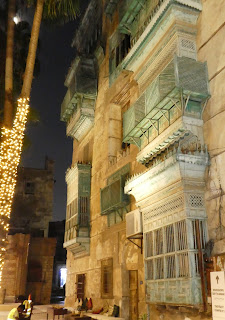
Then there was Jeddah - beautiful Jeddah, with the Ottoman influence in its architecture - still very much under restoration but already a pleasure to wander around both for the architecture but also for the nightlife (I just wish we'd had the time to stop and enjoy the live music being performed in one little square in the old town).  Difficult to photograph given the narrow streets, but this shows the traditional old window screens - there to enable women to observe the street life without being seen.  I would have happily spent many days there.

& finally, in terms of major sights seen on the organised tour, there was the city of Medina. Here is found the Masjid an-Nabawi, the big mosque built around the tomb of the Prophet Mohammed, making this the second holiest city in Islam.  In the past, such places were off-limits to non-Muslim visitors, but whilst we still cannot go inside the mosque, we are now able to go right up to the courtyard surrounding it.

black faces

I have to return to the black-white relations topic, inspired by the recent outcry over racism in British cricket, as I find this so interesting when considered from the African perspective.

I’m thinking of the case where an old picture has come to light of a white cricketer in blackface, where he was apparently playing homage to the (then) recently deceased black artist, Tupac Shakur.  It reminded me of an incident maybe ten years ago, when an Australian politician got into hot water over a blackface incident, at which time I innocently mentioned the case to a Cameroonian colleague.  To my surprise, he was confused by the incident.  “What’s wrong with that?” he asked.  I tried to explain, but he found it very strange, telling me about a popular Cameroonian comedian of the time who was known for making himself up as a white person, and then acting out doing typically local jobs which would not normally ever be done in Cameroon by a white person.  I recall he gave one example of street vendors.  My colleague asked me if I found that offensive – which of course I didn’t.  Perhaps an example of white privilege (a term which I don’t think existed at that time) as you don’t get easily offended by mickey-taking when you are in the dominant group.

So this time around, I asked a Senegalese friend – an educated and well-travelled Senegalese friend – what he thought about what this cricketer had done.  Like my Cameroonian colleague, he was confused, telling me that he and other Senegalese would consider it an honour if a white person made themselves up (clothing but also make-up) as Senegalese in homage to someone who had died.  I asked how he would feel if it were done in a more light-hearted context, rather than as homage to someone deceased, and he still said that he and other Senegalese would view it as something positive, showing recognition and appreciation of Senegalese/Africans.  Indeed when I walk in the street wearing anything local, such as outfits in African wax fabric, I get appreciative comments from random strangers – it is never seen as cultural appropriation but rather as a mark of appreciation and respect.

I suppose the negative reactions to such things usually start in the US, where the history of black-white relations is so bad that any instance of white folk interacting with the black culture is viewed with suspicion.  Not that black-white relations in Africa have been exactly balanced and fair, but perhaps being on ‘home turf’ makes a difference in some way.  Indeed, it still astonishes me how positively white people and white culture are seen here.  On my way back from Lompoul last weekend, as our minibus drove through some small towns and villages, several people looked up and noticed that there were some white people in the vehicle – “Toubab!” (the local word for white person) one older lady shouted excitedly as she waved to me.  I don’t know that I’ll ever fully understand that reaction, but one thing I do know is that when I eventually return ‘home’ to the UK, I shall have to be careful as to what I say and do in respect of the minefield of black-white interactions.

the 18sqkm desert of Lompoul

I should have flown to Ethiopia last Thursday, to start a trip to the Omo Valley and from there by land into Somaliland.  Sadly the British tour company I was going with have panicked about the situation with the rebels, and announced just a few days before departure that they have cancelled the trip.

So I booked a last minute weekend away in northern Senegal, to visit the sand dunes of Lompoul.  Somewhere I'd previously decided was not worth my time and money, but with fewer tourists here right now, and the trip not too pricey, I thought it would be preferable to sitting at home moping about my missed Ethiopia trip.

It was billed as an 'astronomy weekend', as a professor of astronomy was to accompany the group, with his telescopes and a ready-made presentation - not really a selling point for me but once he had taken us through the presentation and pointed out Venus and Jupiter when the clouds parted, I was getting interested - so was sad that the clouds thickened during the course of the evening and we didn't get to see Jupiter, Saturn and the surface of the moon through his telescope.  Nor did I get to see Venus at 6am the next morning, as the downside of sleeping in desert tents is the lack of anywhere to charge your phone, so the battery went dead some three hours before the alarm was supposed to wake me up.

However, I did get to be very touristy and do a short walk around on a camel, and also walked about in the dunes looking at the various animal tracks and watching dung beetles do their thing.


As with many events in Senegal which attract tourists or foreign residents, the other participants were mostly French - and whilst I can converse quite happily in French with the Senegalese (indeed with any French-speaking Africans), I find the accent of the French themselves very hard to understand.  I still somehow finished this weekend with a few new friends, however, and had some interesting conversations.  This included some discussion of the risk to the ecology of this part of Senegal - and the livelihoods of those who work there in the tourist trade - from the imminent exploitation of the mineral zircon which was discovered there a few years ago (this apparently being the fourth largest known source in the world).  What I hadn't known was that the Minister of Mines who signed the deal with a French company to exploit the deposits (in which just 10% of the benefit comes to Senegal) was none other than our current president!

the other parts of my trip to Niger


Whilst the Gerewol was the purpose of my trip, and of course the highlight, I did also visit Agadez, Zinder and Mirriah, and some of the scenes viewed along the roads were also interesting.

This was a fully-laden truck, en-route from Libya to Diffa in the south-east of Niger.  The driver had stopped for a nap in the shade of the vehicle, and hearing that it had taken three days to do part of a road that took us eight hours, I really couldn't imagine it having to go through sandy parts of the Libyan desert!!

We also passed a family of Fulani nomads, with all of their household possessions piled up around them on their donkeys, which were almost as overladen as this truck.  & a group of Touaregs, travelling by camel, but with the camels all in their best leatherwork, decorated noseclips and so on, looking really spectacular.


In the towns and cities we were looking at a mixture of mosques (including the UNESCO-listed sixteenth century mud mosque of Agadez), sultan's palaces, and older districts of traditional architecture.  You can see at the top the eighteenth century sultan's palace in the town of Mirriah, which still has the old drum inside (beaten to announce the appointment of a new sultan) as well as sacks of something mysterious suspended from the ceiling inside the entrance, designed to protect the interior from evil.  Despite the presence of Islamist terrorism in parts of the country, it still holds a variety of traditional beliefs alongside Islam.

& here the front wall of the sultan's palace in Zinder, reputed to have three young girls and four Korans buried within (or under), on the advice from 1850 when it was built of some spiritual guides and hunters, considered to have mystical powers.


Inside included an area where prisoners used to be kept, with three doors to small dark 'rooms' (only shoulder high) where they could be sent to reflect on whether they had any information to divulge: the first where they were just left on their own for a while in the dark; the second where they were accompanied by a scorpion; and the third where they were accompanied by a snake.  Finally from the same area was the Door of No Return - any prisoner passing through here either met his death or was sold into the transatlantic slave trade.  Zinder was a major power along the trans-Saharan trade route.  Bizarrely, the current sultan also has a thing about fancy cars, and inside the palace were two very duty old Rolls Royces alongside a number of other fancy older brands and a ridiculously long limousine that surely has never been out in the streets of the city!

The Birni district of Zinder (around the palace) had some impressive old Hausa architecture, as well as a strange old French cemetery with no markings on any of the gravestones - I've not been able to get any explanation for that.  Agadez also had some nice architecture, and was very pleasant to walk around.


Even aside from the festival, Niger was a rewarding country to visit although, I will admit, not the most comfortable in terms of climate or facilities.

the Gerewol and the Yaké


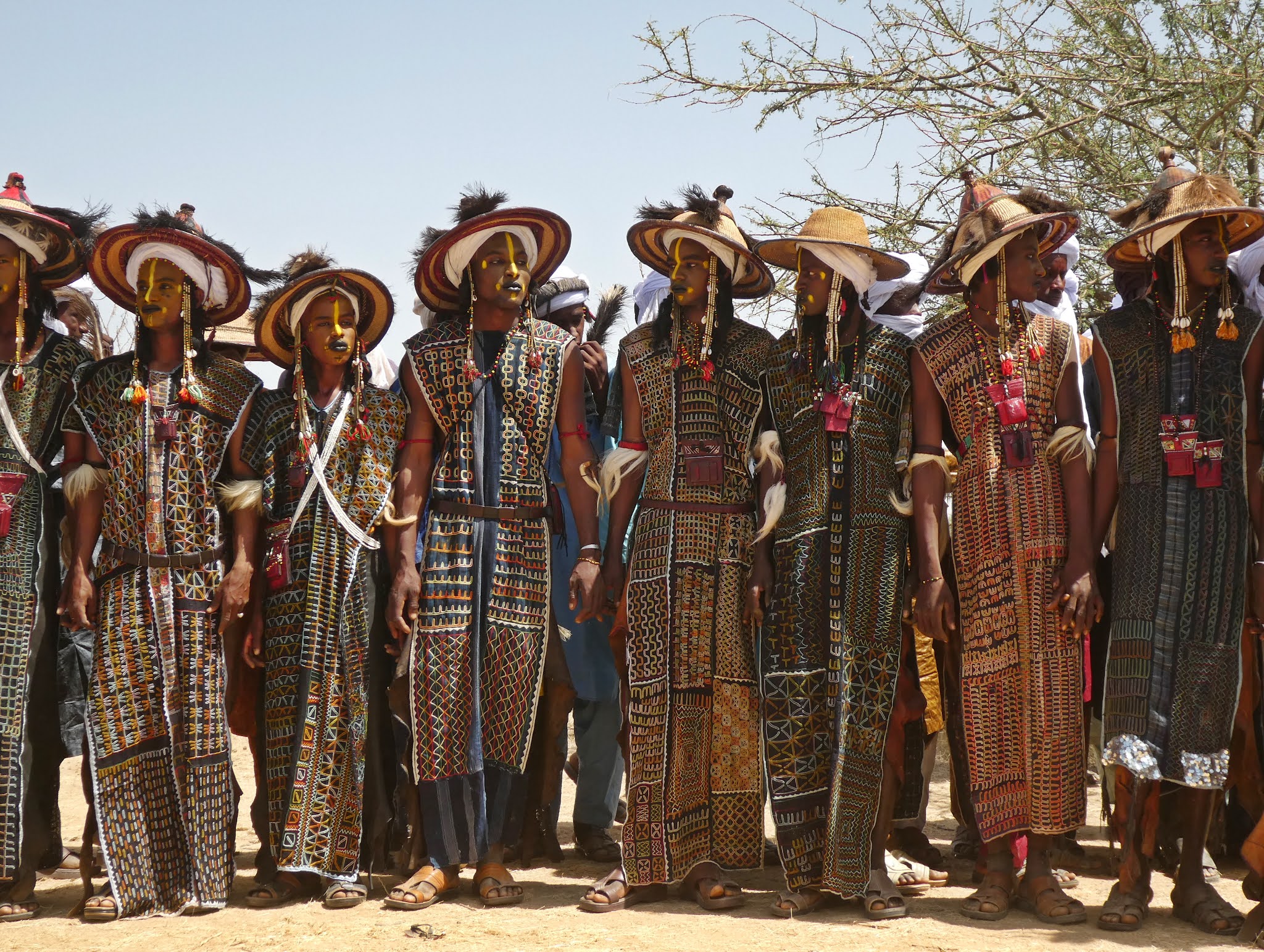
The core of the gathering of nomads that takes place in northern Niger at the end of every year's rainy season is the performance throughout the week of 'dances' by the young men, who are competing to be selected as the most beautiful.  There are two main dances, the Gerewol, after which the festival is named, and the Yaké, which is featured in most of the photographs one might see of the event.  The costumes, make-up and jewellery are traditional, as are the chants and movements that the men perform to show off their attributes.  Height, symmetry of features and white eyes and teeth are prized.

The dances start in the late morning with the Yaké - by far the most impressive, to my mind.  Firstly the men have to prepare, their hair braided (often by a sister), traditional costumes donned, and the make-up carefully applied by the participants themselves.  The yellow (and later red) make up is natural, but I was told that battery acid is used by some to make the black colour applied to the mouth and eyes.  We were able to see all of this preparation taking place, and I have to say that some of the young men were stunning!!

This is a picture of the Yaké dance being performed:

At the same time as the Yaké is taking place, other young men will be preparing themselves for the Gerewol dances which take place during the afternoon and all through the night.  These involve a different costume and different make-up, but with the same objectives.  Here you can see some Gerewol participants showing off the whites of their eyes and teeth!


This is the first, main, part of the performance, which can have around 70 participants, and after which a much smaller number are selected for a 'dance-off', with more vigorous movements. It wasn't clear who makes this selection.  In the Gerewol dance, this 'dance-off' follows the removal of the initial headpiece and the application in its place of a kind of 'plume'.

Female judges (we only saw two per dance, but apparently there can be more) watch their performance and indicate their selected winner by pulling on the plume.  I didn't get to find out how the judges are appointed, but they also sport traditional hairstyles and jewellery, and follow a convention of shielding their faces from the audience with their hands, whilst slowly walking up and down the line of participants to make their choice - not directly looking at them, with their whole performance being very coy.  I also didn't see them make their selection, as despite the presence of men wielding sticks to beat back the audience if they approach the participants too closely, it always descended into apparent chaos at the end, with everyone rushing forward to see who was going to win.

The audience is made up of a mixture of young women - who all stay together - and men, some seated and some standing, and behind them the Touaregs on their camels.  The Touaregs don't participate in the dances (perhaps better termed beauty contests?) and no-one explained to me why they attend.  The women check out the contestants carefully, for this festival is basically - how can I put this? - a chance for the young people to get laid!  With the women in the driving seat.


Apparently the hair protruding over the forehead is the sign that a particular woman or girl is 'up for it' - and there is no judgement against this behaviour, everything is allowed during the festival.  I suppose when you normally spend the year travelling, with just your family group and your animals, this is understandable.  The liaisons can lead to marriage, but they can equally be just a bit of fun - and I heard that the girls can be quite competitive, trying to out-do eachother in the number of beautiful young men they can bed (I also heard that STIs are rife).  The activity is not restricted to single women either - apparently beauty is so highly prized amongst the Wodaabe that a man will accept his wife sleeping with a beatiful dance participant, reasoning that should she become pregnant, the baby will be more beautiful than if he had fathered it himself!!

So, all in all, a lot to take in, and I am still processing what I saw some two weeks after the festival.  It certainly lived up to - and indeed surpassed - my expectations.